


Every year, thousands of students in Nepal open a grade sheet, find a letter next to each subject and a number at the bottom, and have no clear idea what either one actually means for what happens next.
They know A+ is good and D is bad. Beyond that it gets vague fast. Is 3.2 a good GPA? Does a B in Maths close the science stream? What is the difference between a grade and a grade point, and why does the average not look like the average you would calculate yourself?
This is the explanation nobody quite gives you.
Letter Grades Replaced Pass and Fail, and That Changed More Than It Looks
Nepal moved from a marks-and-division system to letter grading, run by the National Examinations Board. The old system sorted students into distinction, first division, second division and pass, with a hard fail below a threshold. The current one gives each subject a letter, converts the letter to a grade point, and averages those points into a GPA.
This is criterion-referenced grading rather than norm-referenced grading, and the distinction matters more than the terminology suggests. Norm-referenced means you are ranked against the other students who sat the exam: if everyone does well, some still land at the bottom. Criterion-referenced means you are measured against a fixed standard: if every student in Nepal met the A+ standard, every student would get A+.
In practice this means you are not competing with your classmates for grades. Their result does not consume one that could have been yours. That is worth internalising, because a great deal of exam stress in Nepal comes from a competitive framing the grading system stopped using.
The Scale, and What Each Grade Actually Represents
Two things about this table are worth pausing on.
The bands are ten marks wide, but the grade points are not evenly spaced. The gap from A to A+ is 0.4 grade points across ten marks. So is the gap from B+ to A. But the effort required to move from 85 to 91 is nothing like the effort required to move from 65 to 71, because at the top you are chasing precision and at the middle you are usually still fixing whole topics. If you are optimising a GPA, the cheap points live in the middle of your grade sheet, not at the top.
A D is a pass, but it is a pass that closes doors. Meeting the minimum in a subject is not the same as being allowed to continue with it. Which brings us to the part that actually decides your options.
How the GPA Is Calculated, With an Actual Example
Your GPA is not the plain average of your grade points. It is the credit-weighted average: each subject contributes in proportion to its credit hours, so a four-credit subject counts more than a two-credit one.
The formula is:
GPA = (sum of grade point x credit hours for every subject) / (total credit hours)
Take a student with these results:
GPA = 86.4 / 26 = 3.32
Now look at what is doing the damage. Five of the seven subjects are B+ or better, two are A+, and the GPA is still 3.32 - because Optional Maths at C+ and Compulsory Maths at B are both four-credit subjects dragging on a mean.
Change only Optional Maths from C+ to B+ - one grade band, on one subject - and the total becomes 89.6, giving a GPA of 3.45. Change both Maths grades up one band and it is 3.58.
Before your next exam cycle, write out this table for yourself with your current grades. The subject with the largest gap between its credit hours and its grade point is where your next study hour is worth the most. It is almost never the subject you enjoy.
This is the single most useful thing to understand about the system: a credit-weighted mean rewards raising your floor far more than raising your ceiling. A student who turns two C+ grades into B+ gains more GPA than a student who turns two A grades into A+, for considerably less work.
Grades in One Subject Versus the Overall GPA
Colleges and universities in Nepal generally apply two filters, and students routinely prepare for only the first.
The GPA filter. A minimum overall GPA to be considered at all. This is the number everyone talks about.
The subject filter. A minimum grade in specific subjects relevant to the programme. Science streams typically require a minimum grade in Science and in Maths specifically. Management programmes may require a minimum in Maths or English. An excellent GPA carried by strong humanities grades does not necessarily qualify you for a science stream if the Science grade itself is below the threshold.
This is why "just get the GPA up" is incomplete advice. If you intend to study science, a B in Science with an overall 3.6 can be a worse position than a B+ in Science with an overall 3.4, depending on where you are applying.
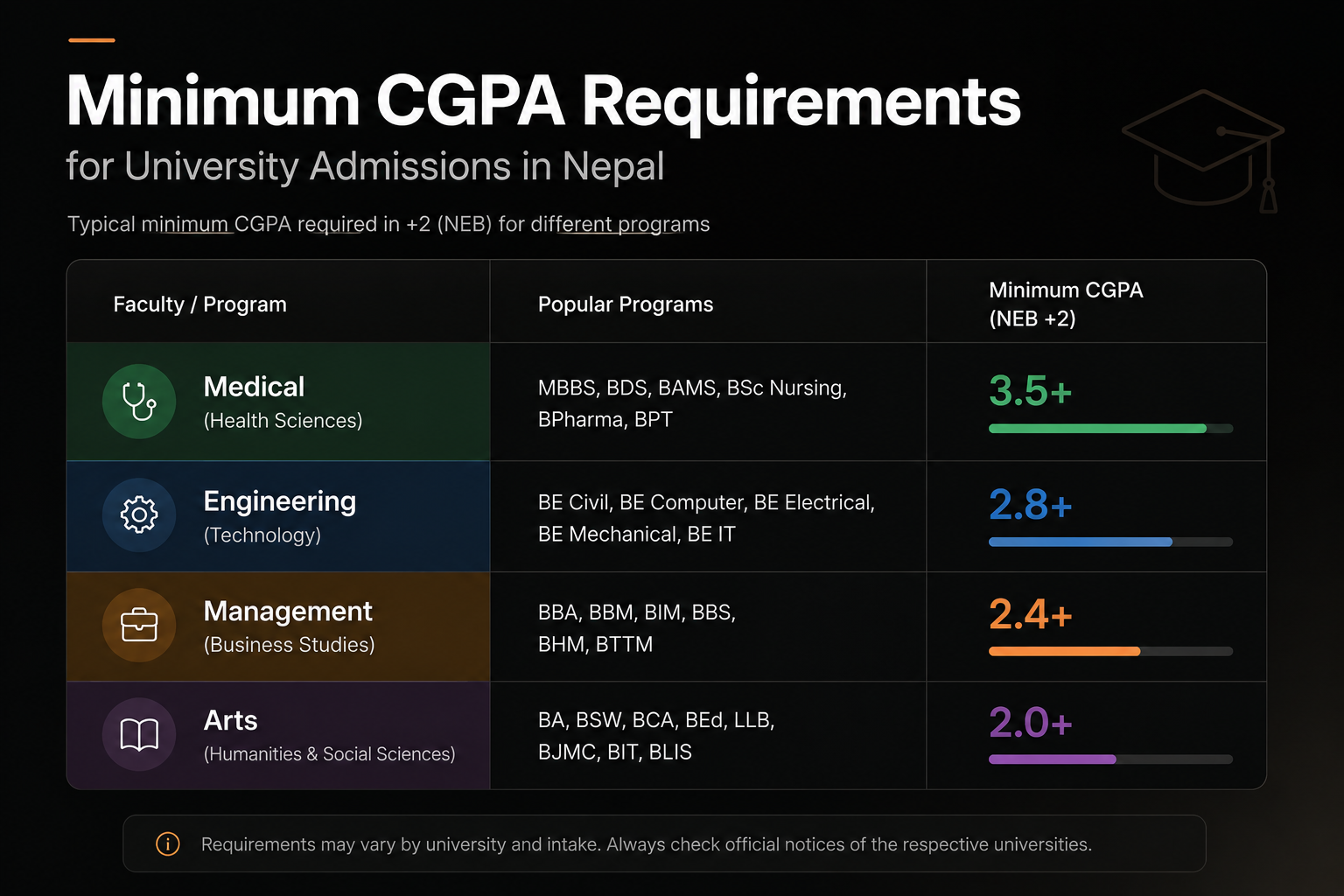
Ask your school - or the colleges themselves - what last year's actual entry requirements were, in both forms. Published minimums and real cut-offs are often different numbers, and the real one is the one that matters.
What Happens If You Do Not Pass a Subject
A grade of E or NG in a subject means that subject has to be re-sat. It does not mean the year is lost, and it does not mean every subject has to be repeated.
Nepal runs grade increment examinations, which serve two different students:
- Those who did not meet the threshold in one or more subjects and need to clear them.
- Those who passed everything but want to improve a grade they are not happy with.
The second case is under-used. Students often assume the grade sheet is final and start planning around a number they could have moved. If one subject is holding your GPA below a threshold you need, find out from your school whether a grade increment sitting is available for it and what the deadline is. The National Examinations Board publishes the official schedule.
Check the rules for the specific year you are in rather than relying on what an older sibling or a forum post says. The number of subjects you may re-sit, and whether an improved grade replaces or supplements the original, have both changed over time. Your school's examination officer is the reliable source.
Reading a Grade Sheet Properly
A few practical things students miss when the sheet arrives.
Theory and practical are often graded separately. In subjects with a practical component, the grade sheet may show separate marks, and the threshold can apply to each. Passing overall while failing the practical component is a real outcome, and it is easy to misread the sheet and not notice.
Credit hours are printed on the sheet. They are the numbers that make your GPA calculation reproducible. If your own arithmetic does not match the printed GPA, it is almost always because you averaged the grade points without weighting them.
Grade points, not marks, drive everything downstream. Two students with 80 and 89 marks in a subject both have an A and both contribute 3.6 to their GPA. Within a band, additional marks buy you nothing. This is why marks just below a boundary are the most painful outcome on any grade sheet, and why checking whether a re-totalling is possible is worth doing when you land at 79 or 89.
Why the System Was Changed at All
It is worth understanding the reasoning, because it explains some things that otherwise look arbitrary.
The old division system had a well-known problem: it created a hard fail that ended a student's formal education abruptly, and it encouraged a mark-hunting culture where the difference between 59 and 60 mattered enormously for a label. Grading in education systems worldwide have moved towards letter grades and grade point averages partly to smooth that cliff and partly to make results comparable across institutions and borders.
The trade-off is real. A GPA compresses information: an A+ and an A are both "excellent" and the sheet does not record which one was 91 and which was 99. Some precision is lost. What is gained is a system where no student is sorted into a permanent category by a single mark, and where a weak subject can be repaired rather than being fatal.
Whether that trade is worth it is a fair debate. But knowing which system you are in tells you how to play it, and the current one rewards consistency across subjects far more than brilliance in one.
SEE and Grade 12 Are Graded the Same Way, but Weighted Differently
The letter scale above applies at both levels, which is why students often assume the two results are interchangeable. They are not, and the difference catches people out at admission time.
At SEE, the grade sheet is the summary of one terminal examination across the Grade 9-10 curriculum. It decides which stream and which college you can enter for Grade 11.
At Grade 11 and 12, the NEB result is what universities and most employers actually look at, and it is assembled from more than one component. Subjects carry a theory paper, and many carry an internal assessment and a practical component alongside it. Each has its own weight, and the subject grade is the combination.
Two practical consequences:
Internal assessment is not free marks, and it is not a formality. It is a real slice of the subject grade, awarded across the year rather than in one sitting. Students who treat classwork, attendance and internal tests as background noise arrive at the terminal exam needing a higher theory mark than their classmates to reach the same grade. This is the most quietly decisive difference between two students with similar ability.
A practical component can be failed separately. In subjects with a lab element, the threshold may apply to the practical as well as the theory. It is possible to be comfortable in a subject on paper and still be pulled down by a component you did not think counted.
If you are in Grade 11 now, ask your college for the exact weighting of theory, internal assessment and practical in each of your subjects. It is a five-minute question and it changes how you allocate a year.
What Each GPA Range Realistically Opens
These are not official cut-offs - they move by year, by institution and by programme, and you should always check the actual requirement where you are applying. But students ask what the numbers mean in practice, and a vague answer helps nobody.
3.6 and above. Competitive science and engineering programmes are realistically in range, including the entrance-exam routes at institutions like Tribhuvan University and Kathmandu University. At this level the GPA is rarely the binding constraint - the entrance examination is.
3.2 to 3.6. Most streams are open, including science at many colleges, though the most competitive programmes will come down to the entrance exam and your subject grades. This is the band where the subject filter matters most.
2.8 to 3.2. Management, humanities and education streams are comfortably in range. Science is possible at some colleges depending on your Science and Maths grades specifically. Worth checking individual requirements rather than assuming.
2.0 to 2.8. Options narrow but do not disappear. Technical and vocational streams, and a number of Grade 11 programmes, remain available. This is also the band where a grade increment sitting on one or two subjects can meaningfully change what is possible.
Below 2.0. The realistic conversation is about which subjects to re-sit and in what order, rather than about admission. That conversation is worth having early with someone at your school rather than late and alone.
The thing to notice across all of these: the difference between adjacent bands is usually one or two subjects, not a general level of ability. That is the encouraging reading of a credit-weighted average, and it is also the accurate one.
Converting a GPA to a Percentage for Foreign Applications
Students applying abroad are regularly asked for a percentage, and there is no single official conversion. Institutions vary, and the honest answer is that you should use whatever formula the receiving institution specifies.
Two things will save you trouble:
Do not invent a conversion. Multiplying your GPA by 25 to get a percentage out of 100 is a common shortcut and it is not something you should put on an application as though it were official. If a form asks for a percentage and you only have a GPA, say so and attach the grade sheet.
Request an official transcript with the grading scheme attached. Most foreign institutions would rather evaluate your grade sheet against Nepal's published scale than trust a number you converted yourself. The scale is documented, and providing it removes the ambiguity entirely.
How to Actually Move a Grade Band
Knowing that one band is worth chasing is useless without knowing how to chase it. A band is ten marks. Here is where ten marks usually hide.
Five to eight marks are typically sitting in careless errors. Units left off, questions half-answered, arithmetic slips, a question misread. Work through your last three marked papers and total up the marks lost to things you knew but did not execute. For most students the number is startling, and it is the cheapest ten marks available anywhere.
Three to five marks are usually in one weak topic. Not the whole subject - one topic that reliably appears and that you reliably fumble. Past papers identify it in an afternoon. Fixing one topic properly is a smaller job than "revise the subject" and it has a bigger effect.
The rest is timing. Marks that were available on questions you never reached. This is fixed by practising complete papers against the clock, not by knowing more.
Notice that only one of those three is about learning more content. Two of them are about executing what you already know, which is why students who "know the material" still land a band below where they expect.
Where Students Get This Wrong
Assuming the GPA is a plain average. It is credit-weighted. A two-credit subject cannot rescue a four-credit one.
Chasing A+ in a strong subject. The marginal GPA gain is small and the effort is large. The same hours spent on a C+ subject move the number considerably more.
Ignoring the subject-specific requirements. A good average with a weak grade in the subject your intended stream cares about is a common and avoidable trap.
Treating the grade sheet as final. Grade increment exams exist. Re-totalling exists. Both have deadlines, and both are missed by students who assumed there was nothing to be done.
Comparing yourself to classmates. The grading is criterion-referenced. Their A+ did not cost you anything.
The Short Version
Your grade is a band, your grade point is a number, and your GPA is those numbers averaged in proportion to credit hours. That last part is the one that matters: raising your weakest four-credit subject by one band does more for your GPA than perfecting your best one.
Find out the GPA and the subject-grade requirements for wherever you want to go next, work backwards from both, and spend your hours where the arithmetic says they are worth the most. That is not cynical - it is just reading the system you are actually being measured by, instead of the one you assumed you were in.