

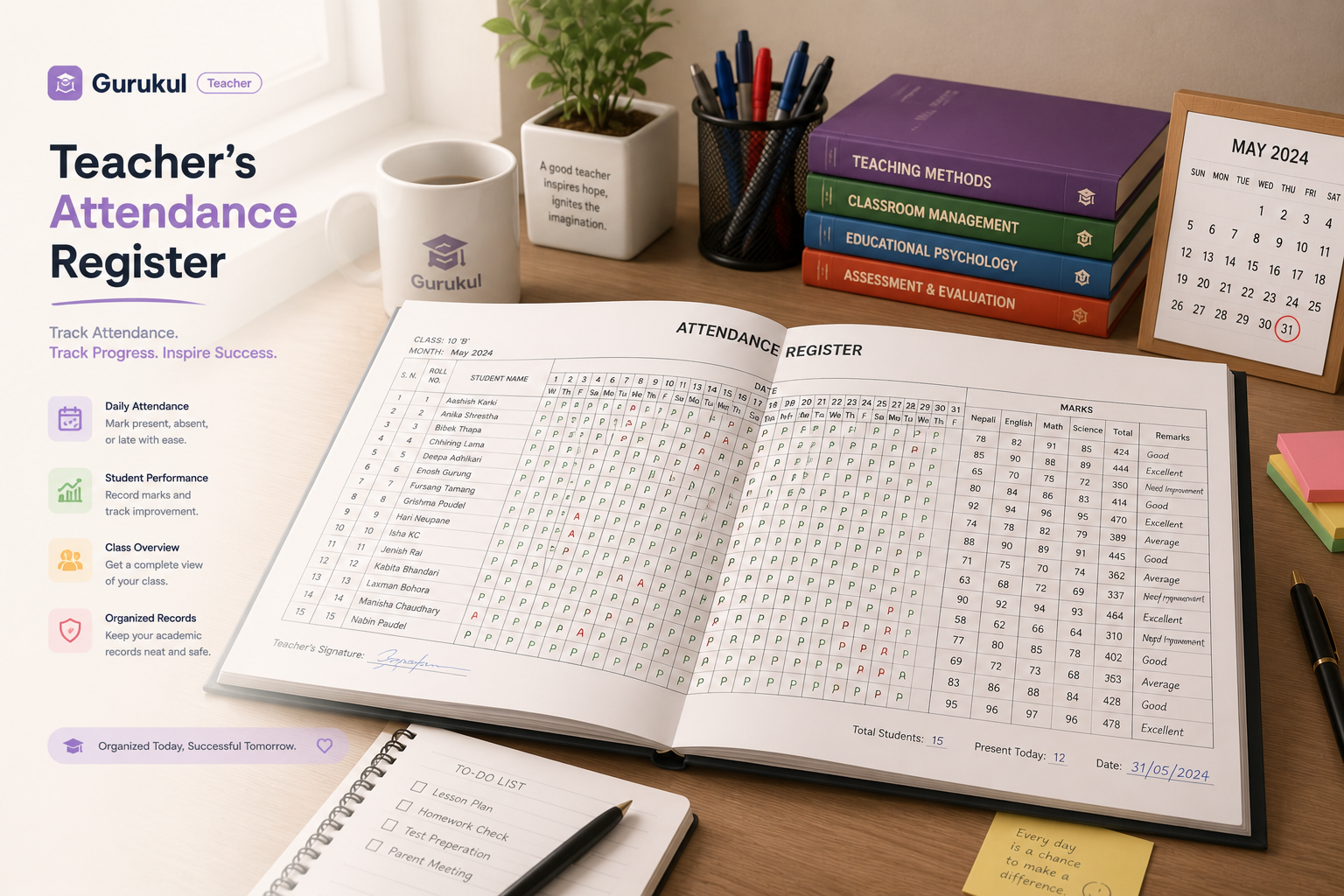
Missing a day of school feels like a small thing. You were sick. There was a family function. The weather was bad. One day out of 220 - how much could it possibly matter?
It depends on how many "one days" there are.
Nepal's schools typically have 220-230 working days per academic year. If a student misses a day here, a day there, the total adds up quickly. By the time they sit the annual exam, their attendance percentage has drifted below thresholds they may not have been watching.
This post explains exactly why attendance matters, what the thresholds are, how it affects exam eligibility, and what to do if your attendance is already low.
The Minimum Attendance Requirement
In Nepal, the National Examinations Board (NEB) and most schools follow a minimum attendance requirement for students to be eligible for annual or terminal examinations.
The typical standard:
- Most schools and the NEB require 75-80% attendance to be eligible to appear in annual examinations
- Some schools set higher internal thresholds - 85% or more - for certain privileges or scholarships
- Missing the minimum threshold means a student may be declared "not eligible" (NE) for the exam
What 75% attendance means in practice:
- If the school year has 220 working days, 75% = 165 days of attendance required
- You can be absent a maximum of 55 days before hitting the threshold
55 days sounds like a lot. But students who miss 2 days per month, every month, for a 9-month academic year have already missed 18 days. Add sick days, family functions, and unexpected closures - 55 days is easier to exceed than most students think.
The Direct Impact on Exam Eligibility
The consequences of falling below the attendance threshold are serious:
Not eligible (NE) for annual exam: A student marked NE cannot appear in the SEE, NEB Grade 11, or NEB Grade 12 annual examination. This means:
- For Grade 10 students: Cannot appear in SEE. Must wait for the next exam cycle or repeat the year.
- For Grade 11/12 students: Cannot appear in NEB. Loses an academic year.
Losing an academic year has cascading effects - university admission, career timelines, and family plans are all disrupted.
Not eligible for internal exams: Many schools set attendance thresholds for internal tests and terminal exams as well. A student with low attendance may be barred from internal assessments before even reaching the annual exam.
Grade records are affected: Some schools record attendance percentage on the report card. Below-threshold attendance appears on the academic record, which can affect applications to certain institutions.
What Drives Attendance Problems
Understanding why students miss school helps with the solution.
Illness: The most common legitimate reason. Short illnesses - a fever, a cold - account for most individual absences. Students who fall behind during illness sometimes avoid school afterward because they fear having missed too much.
Family obligations: In many Nepal households, students are expected to help with family events, care for younger siblings during illness, or assist during agricultural seasons. These absences are often unavoidable.
Avoidance: Students who are struggling academically, facing social difficulties, or experiencing bullying sometimes avoid school to escape the situation. If the underlying problem is not addressed, absences accumulate.
Long-distance commute: Students who travel long distances to reach school - particularly in rural or hilly areas - miss more days due to weather, road conditions, or transport problems.
Specific subject avoidance: Some students are present for most classes but skip specific periods or subjects they find difficult or unpleasant. In schools with flexible scheduling, this can affect attendance records in those subjects.
How Digital Attendance Changes Things
Traditional paper attendance systems have an information delay problem. A student's attendance percentage is calculated at the end of the month (or term) when the register is compiled. By the time a student (or parent) knows their attendance is dropping, it may already be close to the threshold.
Digital attendance systems - like the one in Gurukul - change this fundamentally:
Real-time percentage: Students and parents can see the current attendance percentage at any time. Not at the end of the month - today.
Immediate parent notification: When a student is marked absent, the parent receives a notification that day. This closes the gap between absence and parental awareness that allows problems to compound.
Early warning: A student at 82% attendance in January still has months to improve before the exam. A student who only finds out in April that they are at 74% has much less time.
Dispute resolution: Digital records are timestamped and include which teacher took attendance, at what time. If a student was marked absent but believes they were present, the record can be checked quickly.
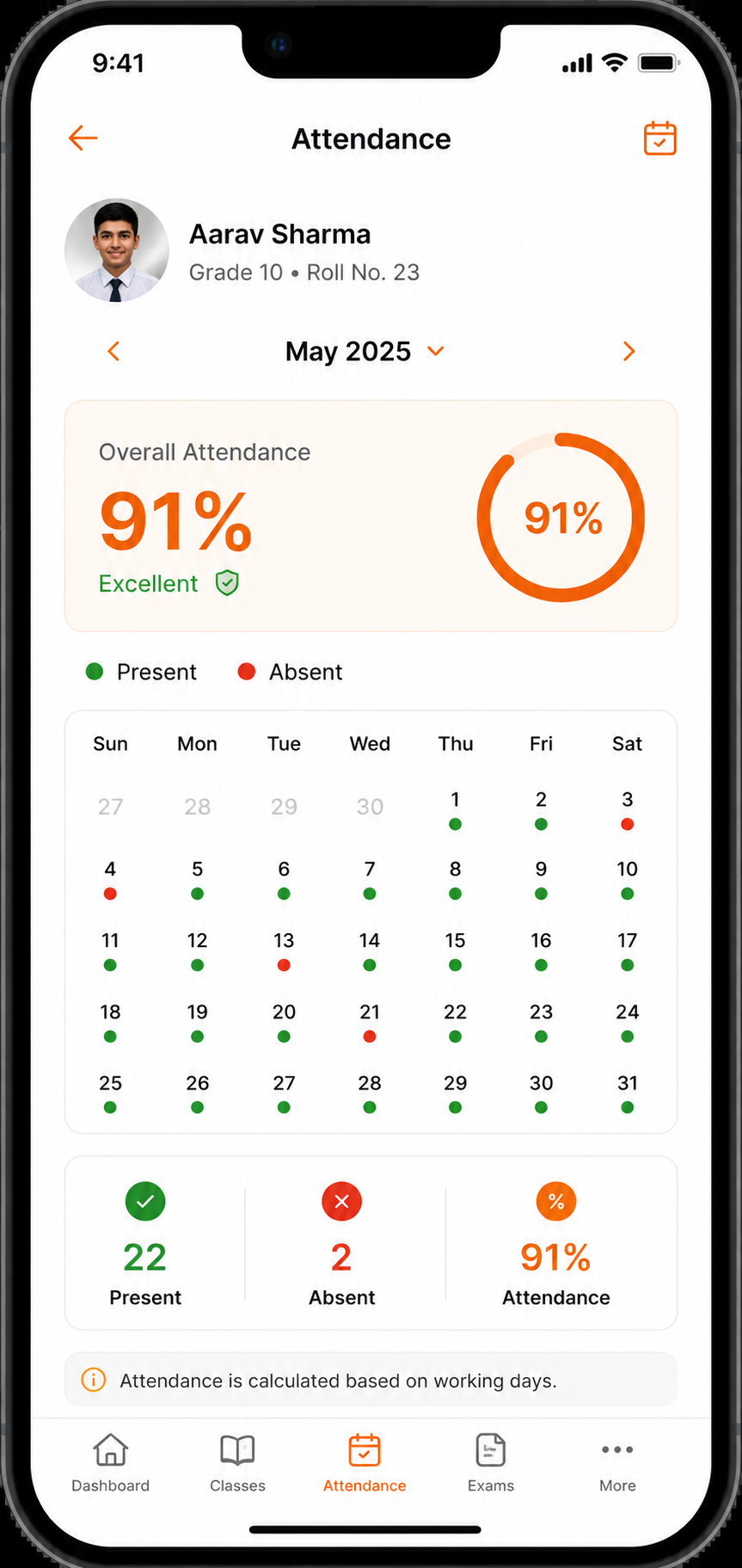
Calculating Your Own Attendance Percentage
You do not need the school to tell you your attendance status. You can calculate it yourself.
Formula: Attendance % = (Days Present ÷ Total School Days) × 100
Example:
- School has had 140 working days so far this year
- You have been present for 118 of those days
- Attendance = (118 ÷ 140) × 100 = 84.3%
Working backward - how many days can you still miss?
- School year total: 220 days
- Minimum required attendance (75%): 165 days
- Days attended so far: 118
- Days remaining in school year: 220 - 140 = 80
- Days you must attend from here: 165 - 118 = 47
- Maximum absences remaining: 80 - 47 = 33 days
If you know the total school days and your current attendance, you can calculate exactly how many more absences you can afford.
If your attendance percentage is currently below 80% and you are in the second half of the academic year, talk to your class teacher immediately. It may still be possible to improve before the exam eligibility cutoff, but only if you act quickly.
What to Do If Your Attendance Is Already Low
Talk to your teacher or school counselor first.
Do not wait until the end of the year to find out you are not eligible. Talk to your class teacher or the school's student affairs office as soon as you know your attendance is low. They can:
- Give you your exact attendance percentage
- Tell you the school's minimum threshold
- Advise on whether medical or family certificates for legitimate absences can be submitted
- In some cases, explain the school's process for special consideration
Submit documentation for legitimate absences.
If your absences were due to illness (hospitalization, extended illness) or documented family emergencies, many schools accept medical or family certificates that may exempt those days from the attendance count. This is not guaranteed, but it is worth submitting.
Attend every remaining school day.
If you are close to the threshold, every remaining school day matters. Missing one more day when you are at 76% is not the same as missing a day when you are at 90%.
Talk to your parents.
This is a conversation many students avoid because they fear the reaction. But your parents need to know. If you cannot appear for the exam, the consequences affect the whole family. Earlier is better - there is still time to recover if the problem is identified early.
Attendance and Learning Continuity
Beyond exam eligibility, there is a less-discussed effect of chronic absenteeism: learning gaps.
Every class you miss is a lesson not received. In subjects where each lesson builds on the previous one - especially Mathematics and Science - missing a class mid-unit can cause confusion that compounds for the rest of the unit. Students who miss many classes often struggle not just with the missed content, but with everything that followed it.
This is why students who miss a lot of school often feel behind and overwhelmed - the absences created gaps, the gaps caused confusion, and the confusion made school feel harder and less rewarding, which sometimes leads to more absences. It is a cycle.
Breaking the cycle requires both attending consistently and addressing the learning gaps that already exist - through extra study, asking teachers for help, or using an AI tutor to catch up on missed content.
A Note on Attendance and Parent Communication
One of the most important changes digital attendance brings is immediate parent visibility.
In a traditional system: a student is absent. The teacher marks the register. The parent may find out that month, or at the end of the term, or never - if the student intercepts the report card.
In a digital system: a student is absent. The teacher marks the digital attendance. Within minutes, the parent receives an SMS or app notification: "Your child was marked absent today."
This is not meant to create a surveillance situation. It is meant to ensure parents are partners in their child's education - that they know when something is happening, in time to respond.
Students who know their parents will be notified that day make different decisions about skipping class than students who know it will only come out at the end of the month.
Why Attendance Predicts Results So Strongly
Schools quote the attendance rule as a regulation. It is easier to take seriously once you see why the number tracks results as tightly as it does, and the mechanism is not the one most students assume.
It is not that being in the room magically transfers knowledge. It is that absence is compounding in a way almost nothing else in school is.
Miss a Maths lesson on simultaneous equations and you have not lost one lesson. You have lost the foundation for the next three, because the following lessons assume it. By the time you notice - usually a fortnight later, on a topic that looks unrelated - you cannot locate the original gap, and "I do not understand quadratics" is actually "I missed the equations lesson in Bhadra".
This is why the research on absenteeism in schools consistently finds effects that are larger than the raw time missed would suggest, and why patterns of scattered absence often do more damage than a single continuous illness. A week off with a doctor's note is one gap you know about. One day a fortnight for a term is fifteen gaps you do not.
Two other mechanisms matter and are less discussed:
You miss the corrections, not just the content. A large part of a lesson's value is the teacher noticing a common mistake and addressing it. Copying a classmate's notes gives you what was written down. It does not give you the five minutes where the teacher explained why half the class got the previous night's homework wrong.
You miss the calibration. Sitting in a room where questions are asked and answered tells you roughly where you stand. Students who attend patchily are consistently the most surprised by their exam results, in both directions.
Reading the Attendance Number Properly
Digital attendance produces a percentage, and students read it far too casually. Three things about that number are worth understanding.
It is cumulative, and it gets harder to move as the year goes on. In the first month, one absence costs several percentage points and one good week repairs it. By Falgun, the denominator is large: a hundred days in, a single absence moves the figure by a fraction of a point, and clawing back from 78% to 80% may be arithmetically impossible in the days remaining. The time to care about attendance is early, when it is cheap - which is exactly when it feels least urgent.
Find out what your school actually counts. Schools differ on whether the percentage is per subject or overall, whether late arrival is a half day, and whether approved leave is excluded from the denominator or counted as present. These are not small details - the same set of absences can produce meaningfully different numbers under different rules. Ask once, at the start of the year.
A borderline figure is a decision, not a fact. If your school's requirement is 75% and you are sitting at 74.6%, that is usually resolved by a person rather than by a spreadsheet, and the conversation goes better if you start it rather than waiting for the letter. Which leads to the part students most often get wrong.
If You Are Already Below the Line
The instinct is to say nothing and hope. It is the worst available option, because attendance is one of the few school problems that gets strictly harder to fix with time.
Go and ask for the exact number today. Not your estimate - the school's figure, and the threshold it is measured against. A surprising number of students who are certain they are in trouble are not, and a surprising number who assume they are fine are two absences away from a problem.
Say why. Schools distinguish, formally or informally, between absence with a reason and absence without one. Illness, a family situation, a documented commitment, a long commute in monsoon - these are handled differently from unexplained absence, and they can usually only be recorded as such if somebody tells the school at the time. Explanations offered after the eligibility list is drawn up carry much less weight.
Ask what the school will accept as remedy. Many schools have a route - extra classes, a written undertaking, making up practical or internal assessment work. It is rarely advertised. It is frequently available if asked for early.
Fix the cause, not the number. If the absences come from a commute that fails in monsoon, a health problem, or work at home, then promising to attend more will not survive contact with the same conditions next month. Say what the actual constraint is. Schools can sometimes accommodate a real constraint; they cannot accommodate one they do not know about.
Attendance Is Not Only a Rule
It is worth separating two different things that both get called "attendance".
Eligibility is the regulatory one: a threshold, in the compulsory education framework, below which you may not sit the examination. It is a hard edge and it is what everybody worries about.
Continuity is the one that decides your grade, and it has no threshold at all. A student at 92% and a student at 78% are both eligible, and one of them has missed nearly three weeks of compounding instruction. Nothing in the rules flags that. It shows up in the result.
Aim at continuity and eligibility takes care of itself. Aim at eligibility and you will spend the year hovering just above a line that was never the point.
The Bottom Line
Attendance seems like a small thing - until it is not. The students who end up barred from exams because of attendance are usually not students who planned to miss school. They are students who each made a series of small decisions, each of which seemed harmless at the time.
Know your attendance percentage. Know the threshold. Track it yourself. If you are using a school that uses Gurukul, you can see it in real time in your student portal.
If your attendance is dropping, address it now - not at the end of the year.
Check your attendance percentage in real time on your Gurukul student dashboard. You can see which days you were absent, your monthly trends, and whether you are on track for exam eligibility. Check your attendance →