

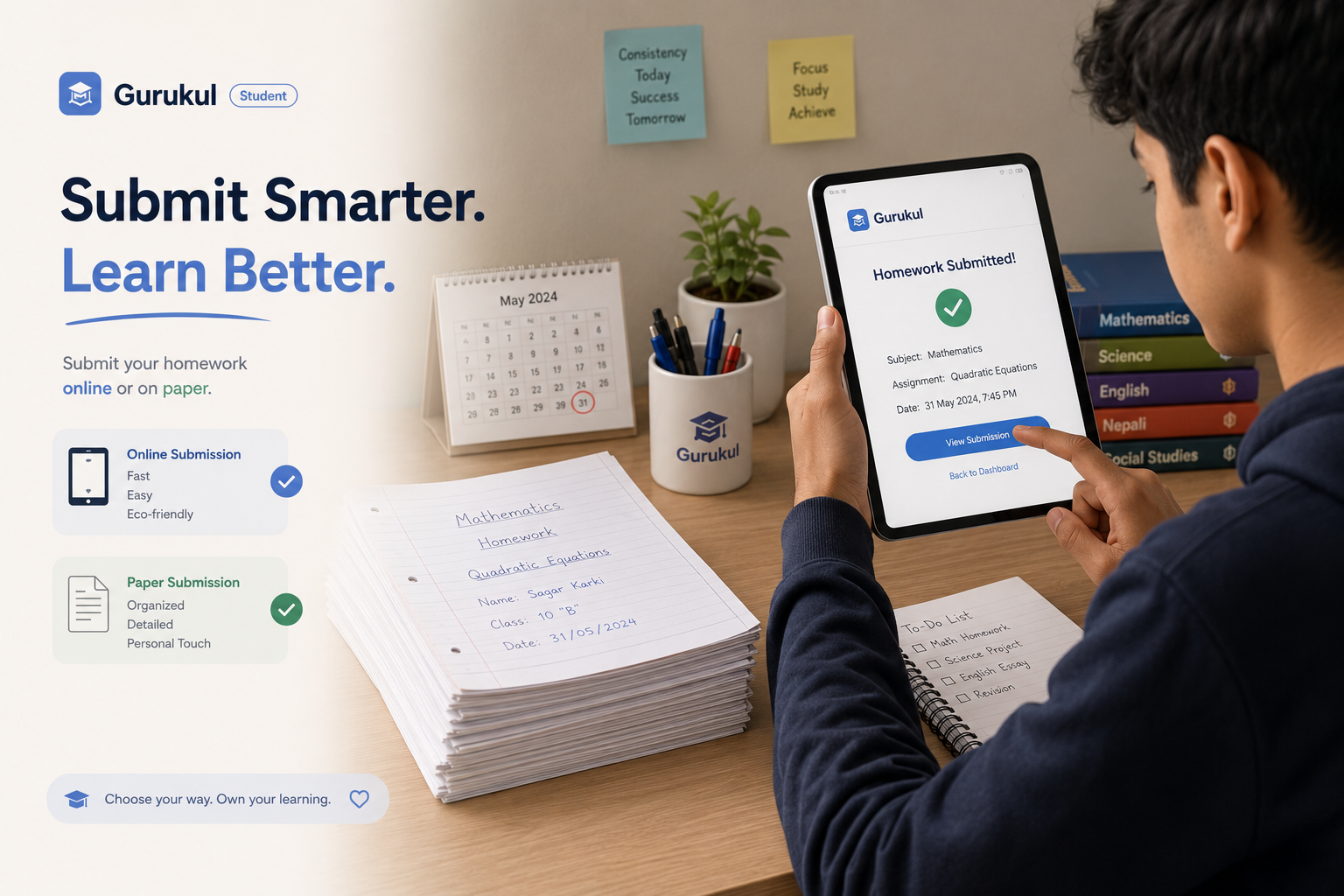
The traditional homework cycle in Nepal's schools goes like this:
Teacher assigns homework on Monday. Students complete it by Tuesday - some do it Sunday night, some do it Tuesday morning on the bus. Teacher collects it Tuesday. Marks it over the next few days. Returns it Friday, or the following week. Students look at the marks, maybe look at the red marks, and move on.
Between the work and the feedback: 3-7 days. By then, the student has moved on to new topics. The feedback is late, the connection between the mistake and the correction is weak, and the learning value of the homework is much lower than it could be.
Digital homework management changes this feedback loop. When you submit homework digitally, the feedback can come within hours - sometimes within minutes. That is a fundamentally different experience.
What Digital Homework Management Actually Is
"Digital homework management" sounds technical. In practice, it means three things:
1. Teachers assign homework digitally - through the school's student portal. You receive a notification. The assignment appears in your portal with a description, due date, and any attached files (a PDF of the questions, a diagram to analyze, etc.).
2. You submit your work digitally - by uploading your answers, typing them in, or in some cases scanning a handwritten page. The submission is timestamped.
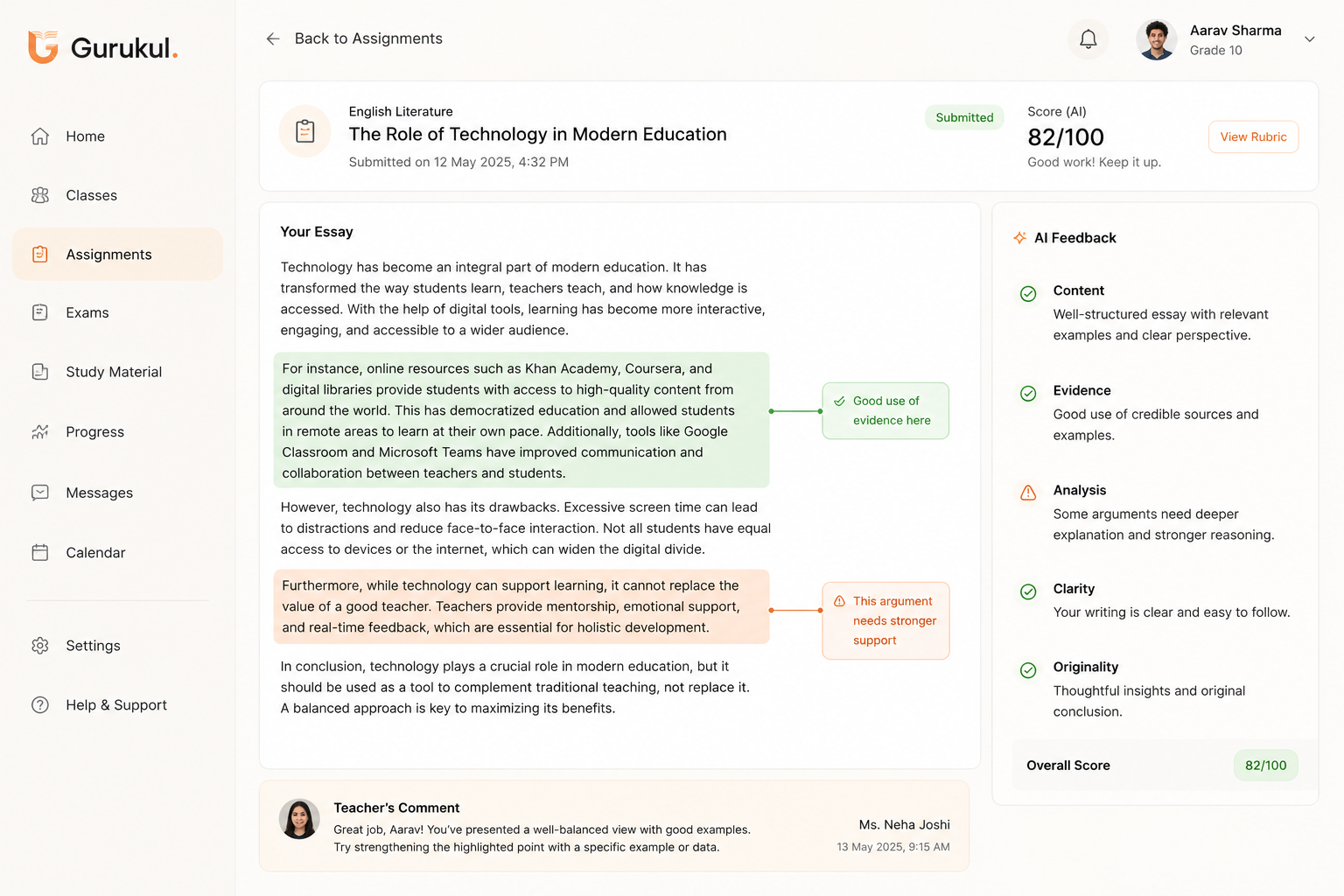
3. Feedback comes digitally and quickly - either from your teacher (who marks in the portal) or from an AI grading assistant that can give preliminary feedback while your teacher reviews.
In Gurukul, all three of these happen within the student portal. When a teacher assigns homework, you get a notification. When you submit, it is recorded instantly. Feedback from the AI grading assistant comes quickly, and your teacher's review follows.
The Feedback Speed Advantage
This is the core benefit. Consider two scenarios:
Scenario A - Paper homework: You submit an essay on Wednesday. The teacher marks it over the weekend. You get it back the following Tuesday - 6 days later. You see you lost marks on "argument structure." You are now in a completely different chapter. You look at the comment, feel vaguely discouraged, and do not apply the lesson in any meaningful way before the next assignment.
Scenario B - Digital homework: You submit an essay on Wednesday evening. The AI grading assistant reviews it and sends you preliminary feedback within the hour: "Your introduction states the position clearly. The first paragraph supports it with a good example. The second paragraph introduces a new argument without connecting it back to your opening position. Consider adding a transition sentence."
You read this Wednesday night, while the essay is still fresh in your mind. You understand exactly what the feedback means. When you write the next essay the following week, you remember the feedback because you received it recently.
Feedback received close in time to the work is acted upon. Feedback received a week later rarely is.
AI Grading Assistance: What It Does and What It Does Not
Some students hear "AI grading" and worry that a computer is evaluating their work without human judgment. Here is what actually happens in a system like Gurukul:
What the AI does:
- Checks for completion (did you answer every question?)
- Identifies structural issues (in essays: missing introduction, unsupported claims)
- Flags potential factual errors (if the question has a clear correct answer)
- Provides initial feedback and a preliminary assessment
- Suggests specific areas for revision
What the AI does not do:
- Make final grading decisions on its own
- Evaluate nuanced arguments or creative writing quality
- Replace your teacher's judgment
- Generate your grade for your report card
The AI gives your teacher a head start. Instead of marking from scratch, your teacher reviews the AI's preliminary assessment, adds their own judgment, corrects anything the AI missed, and provides the final grade. The student benefits from faster feedback; the teacher benefits from less starting-from-zero marking.
Homework Submission Timestamps and Accountability
Paper homework has an honesty problem: you can claim you did it and lost it, or that you did it over the weekend and your bag was left at a relative's house. Digital homework removes this ambiguity.
Every digital submission is timestamped. If the homework was due at 8pm Tuesday and you submitted at 7:52pm Tuesday, that is recorded. If you submitted at 9:14pm - 74 minutes late - that is also recorded.
This creates clarity on both sides:
- Students know exactly when they submitted and cannot claim uncertainty
- Teachers have an accurate record without having to trust students' accounts
For students, this accountability is actually a benefit. You cannot lose the homework. You cannot have it not reach the teacher. Your submission record is clean and verifiable.
Connecting Homework to AI Tutoring
One of the most useful features in Gurukul is the connection between homework and Vidya, the AI tutor.
When you are working on a homework assignment and you get stuck on a question, you can open Vidya with the context of that assignment already loaded. Instead of explaining the entire problem from scratch, you can say "I am working on Question 3 from today's science homework" and the AI already knows what the question is.
This changes how you get help. Instead of: "I don't understand osmosis."
You can say: "I'm working on Question 3 - it says 'explain what happens to a red blood cell placed in a hypertonic solution.' I know osmosis involves water moving across membranes but I'm not sure which direction it goes here."
The AI gives you a targeted, specific explanation for the exact question you are trying to answer. You understand it. You write your own answer. You have learned something.
This is the feedback loop that makes digital homework valuable: assignment → struggle → targeted AI help → understanding → answer → AI/teacher grading → specific feedback → better next assignment.
Building the Homework Habit
Digital or paper, the most important homework habit is doing it consistently and purposefully. Here is what that looks like:
Same time every day: Homework done at the same time every day becomes automatic. The decision fatigue of "when should I do my homework?" disappears. After school, after dinner, before school - pick the block that works and protect it.
Do the hard subject first: Students naturally gravitate toward the homework they find easiest. This feels productive but means the hard subjects get your most tired attention. Do Maths homework before you do the reading comprehension you find easy.
Use homework as a diagnostic: If you consistently struggle with a certain type of question in your homework, that is telling you something. You are weak there. Address it before the exam.
Do not copy from classmates: This is the same principle as not using AI to answer for you. Homework that you copy does not build anything. When the exam arrives, the knowledge needs to be in your head, not in your classmate's notebook.
What to Do When You Do Not Understand a Homework Question
This is where many students get stuck: they stare at a question they do not understand, feel frustrated, and either skip it or copy from someone else.
Neither builds learning.
The right sequence:
- Try the question. Write down whatever you know about the topic, even if it is incomplete.
- Re-read the relevant textbook section.
- If still stuck, ask Vidya (or your AI tutor) the specific question - with context. "I am working on this question: [question]. Here is what I understand: [what you understand]. Here is what I don't understand: [the specific confusion]."
- Get the explanation, then write your own answer in your own words. Do not paste the AI's explanation directly.
- If still confused after all this, bring the question to your teacher the next day.
The point is not to have an answer. The point is to have understanding.
Submit your homework even if it is incomplete. Partial answers often receive partial marks, and your teacher can see exactly where you got stuck. "Attempted but incorrect" is much better for your learning - and often better for your grade - than "blank."
The Record of Your Learning
One underappreciated benefit of digital homework: it creates a record.
With paper homework, your work is either returned and lost somewhere in your bag, or not returned at all. There is no way to look back at what you submitted three months ago and see how your work has changed.
With digital homework, your submissions are stored. You can look back at an essay you wrote in February and compare it to one you wrote in April. You can see your marks across all homework in a subject over the term. You can see which topics consistently cause you trouble and which you have mastered.
This longitudinal view of your own learning is difficult with paper. It is automatic with a well-designed digital system.
Why Fast Feedback Changes the Grade
The case for digital homework is usually made in terms of convenience - no lost sheets, no forgotten deadlines. That is true and it is the least interesting part.
The part that moves a grade is the gap between doing the work and finding out whether it was right.
Homework is formative assessment: its purpose is to inform what you do next, not to record what you know. That is different from summative assessment - the terminal exam - which measures and does not teach. The value of formative work collapses as the delay grows, because feedback only corrects a behaviour you can still remember performing.
Concretely: you solve ten problems on Sunday using a method you have slightly misunderstood. Marked and returned the following Friday, the correction arrives after you have practised the wrong method four more times and stopped being able to recall your reasoning. Returned on Monday, it costs you one wrong repetition and you still remember what you were thinking.
Same teacher, same comment, radically different value. Everything a digital homework system does well is downstream of shortening that gap.
Using AI Grading Without Being Misled By It
Where AI assists with marking, it is worth knowing precisely what kind of judgement you are receiving.
It is reliable on structure and mechanics. Whether a formal letter has the required parts. Whether an answer addressed the question asked. Whether working was shown. Whether the units are there. These are rule-checks, and they are exactly the marks students most often lose - which makes fast, consistent checking of them genuinely valuable.
It is less reliable on judgement. Whether an argument is persuasive, whether an interpretation of a poem is defensible, whether an unusual but valid method deserves full credit. These require a marker who knows the syllabus, the marking scheme, and you.
Two habits follow, and they are the difference between the tool helping and the tool flattering you.
Read the reason, not the score. A number tells you nothing you can act on. "The conclusion introduces a new point" tells you what to do differently on the next one. Students who look only at the mark get no benefit from any marking system, automated or human.
Disagree when you disagree, and take it to your teacher. If you believe a correction is wrong, you may well be right. Bringing a specific disagreement to a teacher is one of the highest-value conversations available to you, and it is a far better use of their limited time than asking them to mark a fourth draft.
Treat an automated mark as a first read, not a verdict. Your teacher's judgement is the one the exam board's marking scheme is closest to, and where the two conflict, the teacher wins.
The Habit That Actually Matters
A homework system removes the excuses. It does not supply the habit, and the habit is where the grade comes from.
Same slot, every day. Homework done at a predictable hour stops being a decision. Homework done "when I get round to it" competes with everything else in the evening and reliably loses.
Attempt everything before asking anything. Ten genuine minutes on a question you cannot do is worth more than the answer, because it tells you exactly where your understanding stops. Ask afterwards, and the explanation lands on a real question.
Do not submit at the deadline if you can submit earlier. A submission with a day in hand can be revised after you notice the mistake in the shower. A submission at 11:58pm cannot.
Read every returned comment, once, properly. This takes four minutes a week and is skipped by most students, which makes it the cheapest available advantage in the whole system.
Homework as a Record You Can Actually Use
The under-used feature of any digital homework system is that it accumulates a history, and history answers questions guesswork cannot.
Before an exam, look back across a term's returned work and ask three things:
Which topics keep coming back with corrections? That is your revision list, assembled by evidence rather than by feeling. It is almost never the list you would have written from memory.
Are the losses knowledge or execution? Comments about wrong methods mean revise. Comments about missing units, unfinished answers and misread questions mean slow down. These need opposite responses, and applying the wrong one is why students revise hard and improve nothing.
Is the same comment recurring? A correction that appears three times is a habit, not a slip, and habits are fixed deliberately rather than by intending to be more careful.
This is deliberate practice in the strict sense - work aimed at a specific identified weakness rather than general repetition - and a term of marked homework is the only readily available source of that information about yourself. Most students never open it.
The Bottom Line
Digital homework management is not about making homework easier. The homework is the same - the same questions, the same effort required. What changes is the feedback loop: faster, more specific, and connected to the AI tutoring help you need when you are stuck.
Students who use digital homework systems effectively - submitting on time, reading feedback carefully, using AI help for stuck points, and applying lessons to the next assignment - build skills more rapidly than students working with delayed, paper-based feedback.
The homework is the practice. The feedback is the coaching. Digital makes both faster.
Your homework assignments from school appear in the Gurukul student portal. Submit digitally, get AI feedback, and connect to Vidya for help when you are stuck. View your homework →