

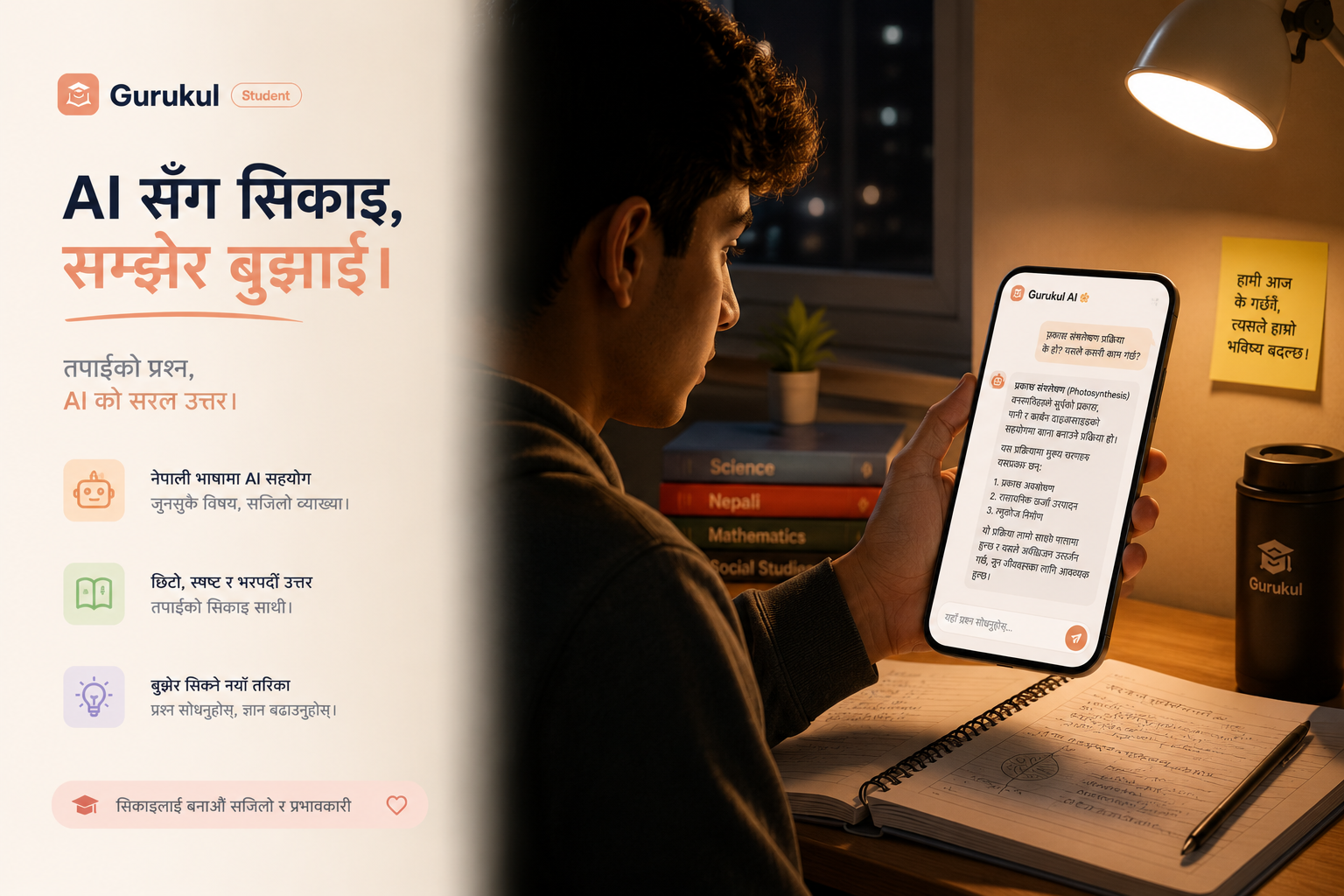
The strongest argument for an AI tutor is not that it is clever. It is that it is awake.
A student in Nepal working through a physics problem at eleven at night has, historically, had three options: guess, skip it, or wait until tomorrow and probably forget to ask. Their teacher is asleep. Their tuition class is on Saturday. The one classmate who understands electricity is not answering.
That is the gap. Not "AI replaces teachers" - a claim that is both overblown and unhelpful - but the far more mundane one that most confusion happens outside the hours when help is available, and unresolved confusion in Maths and Science compounds into a lost grade.
This post is about what an AI tutor genuinely does well, where it fails, and how to use one without quietly destroying your own learning in the process.
What "AI Tutor" Actually Means
The term covers two quite different things, and the difference matters.
A general chatbot is a large language model with no knowledge of your curriculum, your school or your marks. It is enormously capable and completely context-free. Ask it about circle theorems and you get a competent answer aimed at nobody in particular.
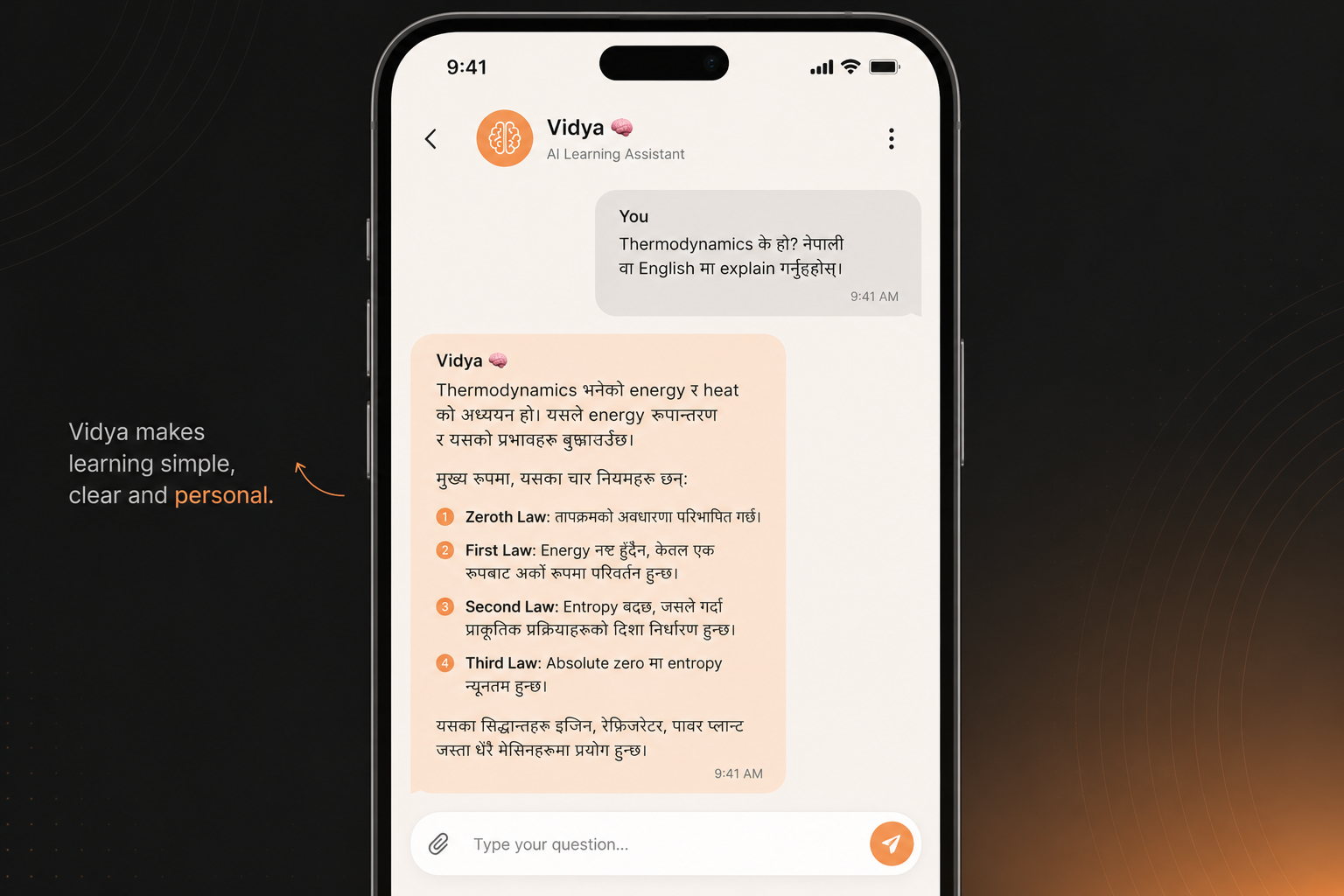
A school-integrated tutor - Vidya in the Gurukul student app is one - is the same underlying capability with your context attached: your class, your subjects, your syllabus, in some cases your attendance and marks. Ask it the same question and it can answer against the curriculum you are actually examined on.
The distinction is the whole ballgame for exam preparation. An explanation of quadratic equations that is technically excellent but aimed at a different syllabus, with different notation and different question conventions, is worth much less to a student three months from the SEE than a mediocre explanation aimed at theirs.
Neither is what researchers historically meant by an intelligent tutoring system - decades of work on software that models what a student knows and adapts to it. Current AI tutors are less structured than that and far more flexible. The interesting question is whether the flexibility makes up for the missing model of you, and the honest answer today is: partly.
Why One-to-One Help Matters So Much
There is a well-known result in education research called Bloom's 2 sigma problem: students taught one-to-one performed dramatically better than students in a conventional classroom - by around two standard deviations in the original studies. The effect size has been debated and refined since, but the direction has never seriously been in question.
The problem in the name is that one-to-one tutoring for every student is unaffordable almost everywhere, and comprehensively so in Nepal. A class of fifty is not a failure of the teacher; it is arithmetic.
What one-to-one provides is not more information. Textbooks have the information. It provides three things a class of fifty structurally cannot:
- Answers to your specific confusion, rather than to the average confusion of the room.
- Immediate feedback, while the attempt is still in your head, instead of a week later on a marked script.
- Unlimited patience, so asking the same thing a fourth time costs you nothing socially.
An AI tutor delivers all three, imperfectly and at essentially zero marginal cost. That is the actual case for it, and it does not require anyone to believe it is as good as a great teacher.
What It Genuinely Does Well
Explaining the same thing differently
This is the strongest use and the most underrated. Textbook explanations are written once, for a general reader. If that particular framing does not land for you, re-reading it a fifth time will not help - the framing is the problem.
Ask for a different one. Ask for an analogy. Ask for a worked example with smaller numbers. Ask what the formula is doing, not what it is. The tutor will produce a fresh explanation as many times as you ask, which is a thing no textbook and few teachers with fifty students can do.
Generating unlimited practice
"Give me five SEE-style questions on circle theorems, hardest last." You now have practice material that did not exist a moment ago, on the exact topic you are weak in.
Then work them, and - this is the part students skip - ask it to check your method, not just your answer. The method is what a marker sees and what partial marks are awarded against.
Feedback on writing
Write a Nepali essay or an English composition, then ask: what would a marker take marks off for here?
The response is usually specific and structural - a missing salutation in a formal letter, a paragraph that states a point without supporting it, a conclusion that introduces something new. This kind of per-draft feedback is otherwise almost impossible to get, because no teacher can mark forty students' fourth drafts.
Testing you
The most valuable prompt most students never use: "Ask me ten questions on the digestive system, one at a time, and tell me if I am wrong."
This flips the tool from explanation to retrieval, which is where actual learning happens. Everything in the study-habits research points the same way: producing the answer beats reading it. An AI tutor used as an examiner is worth several times an AI tutor used as an encyclopaedia.
Answering the questions you are embarrassed to ask
A real and under-discussed benefit. Students routinely will not admit in front of a class that they never understood something from two years ago. That gap then sits under everything built on top of it.
An AI tutor has no opinion about what you should already know. Asking it to explain fractions in Grade 11 costs you nothing, and closing a two-year-old gap is often worth more than anything else you could do that week.
Where It Falls Short
Being straight about this matters, because a student who trusts the tool uncritically will eventually be burned by it.
It can be confidently wrong
Language models produce fluent, plausible text, and fluency is not accuracy. When a model states something false with complete confidence, that is a hallucination, and it is a property of how these systems work rather than a bug that has been fixed.
For a student this is most dangerous in exactly the places you are least able to catch it: unfamiliar topics, specific dates and figures, and anything where the syllabus differs from the international default.
The rule: verify anything you will be examined on against your textbook. Use the tutor to understand, use the book to confirm. A concept explained well and then checked is worth having. A date memorised from a chat window is a risk.
It does not know your syllabus unless it was built to
A general chatbot will happily teach you a method your board does not use, notation your marker will not recognise, or content that is simply not in the Nepali curriculum. It is not wrong, exactly - it is answering a different question than the one your exam will ask.
It does not know what you already know
A human tutor notices that you have nodded at something you clearly did not follow. An AI tutor takes your word for it. It has no model of your gaps unless you describe them, which means the responsibility for aiming the help correctly sits with you.
It removes the difficulty that produces learning
This is the deepest problem and the one that does not look like a problem.
Learning happens at the edge of what you can do - roughly what Vygotsky called the zone of proximal development - and it requires struggling with something slightly too hard. An AI tutor can remove that struggle instantly and completely. Every time it does, the difficulty that would have produced the learning is gone, and you are left with a correct answer and no new ability.
This is why "it explained it and I understood" is such an unreliable signal. Understanding an explanation is easy. Producing the answer next week is the thing being tested.
How to Use One Without Damaging Your Own Learning
Attempt first, always
Do not open the tutor on a problem you have not tried. Give it a genuine ten minutes. The value of the explanation afterwards is many times higher, because you now know precisely where you got stuck, and the explanation lands on a real question instead of a blank.
Ask for hints before answers
"Give me a hint, not the solution" is the single most useful sentence you can type into an AI tutor. Then another hint if you need one. You want to arrive at the answer with assistance, not receive it.
Better still, ask it to work in the Socratic style: "Do not tell me the answer. Ask me questions until I get there myself." Most tutors will do this well if asked, and almost no students ask.
Close the loop
After any explanation, do the thing that converts it into learning: close the chat and redo the problem from scratch. If you cannot, you did not learn it - you watched it. Re-open and go again.
Be specific
"I do not understand trigonometry" gets you a generic overview. "I understand sin, cos and tan as ratios but I do not see why sin(90 - x) = cos(x)" gets you the actual answer to the actual confusion. This is most of what people mean by prompt engineering, and for students it reduces to one habit: describe what you do understand, then where it stops.
Use it in your own language when that is clearer
If a concept is not landing in English, ask for it in Nepali. Understanding the idea first and then learning the English terminology for the exam is a perfectly good order to do things in, and it is faster than fighting the language and the concept simultaneously.
Four prompts that cover most of what an AI tutor is good for: "Explain this differently." "Give me a hint, not the answer." "What would a marker take marks off for in this?" "Ask me ten questions on this, one at a time."
The Line Between Help and Cheating
Worth stating plainly, because the honest version is more useful than the moralising one.
Asking an AI to explain a concept is studying. Asking it to write your homework is not. The clear cases are clear.
The blurry middle is where students actually live: asking for a "structure" for an essay and then filling it in, asking it to check work and accepting every change, asking for a worked example that happens to be the exact homework problem with different numbers. Most schools' academic integrity rules were written before any of this and do not resolve it cleanly.
Here is a test that resolves it for practical purposes, whatever your school's rules say:
Could you produce this again, alone, in an exam hall, next month?
If yes, the AI helped you learn. If no, it did the work and you are carrying an inflated sense of your own preparation into an exam that will not be fooled. The mark on the homework is not the point. The homework is practice for the exam, and practice someone else did for you is not practice.
The failure mode is not moral, it is practical: a student who has an AI write their assignments for a term arrives at the terminal exam having genuinely practised nothing, and finds out too late.
Cost, Access and the Realities Here
Two practical points specific to studying in Nepal.
Connectivity. An AI tutor needs a connection, and plenty of students do not have a reliable one. Batch your connected work: write down the questions you get stuck on during offline study, and ask them all in one session when you have signal. This is a better habit than asking constantly anyway, because it forces the attempt-first rule.
Cost. Credit-based access means questions have a price, however small, which changes behaviour - usually for the better. A student with unlimited access asks the tutor everything, including things they could have worked out. A student with finite credits attempts first and asks about what actually defeated them, which is the correct order.
Using It Well in Each Subject
The general advice above applies everywhere. These are the specific moves that work per subject.
Mathematics. Do not ask for solutions. Ask for the next step only: "I have got to this line and I am stuck - what should I be looking at?" Then continue yourself. When you finish, ask it to check the method rather than the answer, because marks in the SEE and NEB papers are awarded against steps.
The other high-value use is diagnosis. Paste a problem you got wrong along with your own working and ask: "Where exactly did this go wrong, and is it a concept error or an arithmetic slip?" That distinction decides whether you need to revise a topic or slow down, and students almost never separate the two on their own.
Science. Best used for the "why" questions the textbook does not answer. Why does the pressure increase, why is the image inverted, why does that reaction need heat. Textbooks in the Nepali curriculum are generally solid on what and thin on why, and the why is what makes the what memorable.
Also ask it to produce labelled-diagram questions: "Describe a diagram of the human eye and ask me to name each part." Diagram marks are among the most reliable in the paper.
English. Draft, then ask for a marker's view. Then - the step that matters - rewrite it yourself rather than accepting suggested text. Asking "rewrite this paragraph better" produces a better paragraph and no improvement in you. Asking "what is weak about this paragraph and why" produces a worse paragraph today and a better writer next month.
For grammar, ask for exercises rather than explanations. Ten transformation questions beat a page about passive voice.
Nepali. The tutor is useful for grammar rules and for checking a composition's structure. Be more careful than usual with literature: coverage of Nepali texts is thinner than for English ones, and this is exactly the territory where a model will produce confident, fluent, wrong detail about an author or a poem. Verify against your textbook.
Social Studies. Excellent as a question generator for the sheer volume of dates, definitions and figures this subject requires. Poor as a source of those dates and figures. Ask it to test you on your notes; do not ask it to supply the notes.
A Realistic Weekly Pattern
To make this concrete, here is what regular use looks like for a student in exam year - roughly twenty to thirty minutes of tutor time across a week, not hours.
During study. Keep a running list of the things that defeated you. Do not break your session to ask - the interruption costs more than the answer is worth, and half of them resolve themselves ten minutes later.
Twice a week, one session. Work down the list. Attempt-first has already happened, so every question is a real one. Ask for hints before answers.
Once a week, get tested. Pick the topic you are least confident in and ask the tutor to examine you on it, one question at a time, out loud if you can. Fifteen minutes of this is worth an evening of re-reading.
Before a written subject, one draft. One essay or letter, one round of marker-style feedback, one rewrite by you.
That is it. Students who use an AI tutor for hours daily are usually using it as a substitute for thinking. Students who use it for twenty focused minutes a week are usually using it as a substitute for being stuck, which is what it is for.
What It Cannot Replace
An AI tutor does not know you are struggling because something is going on at home. It will not notice that you have gone quiet for two weeks. It cannot write you a recommendation, argue your case, or decide that you have more in you than your last result suggested.
It answers questions extremely well and it is available at eleven at night. That is a genuinely large thing, and it is not the same thing as a teacher.
Use it for what it is: the most patient explainer you will ever have access to, and a tireless examiner if you ask it to be. Then close it, and see whether you can do the problem on your own.