

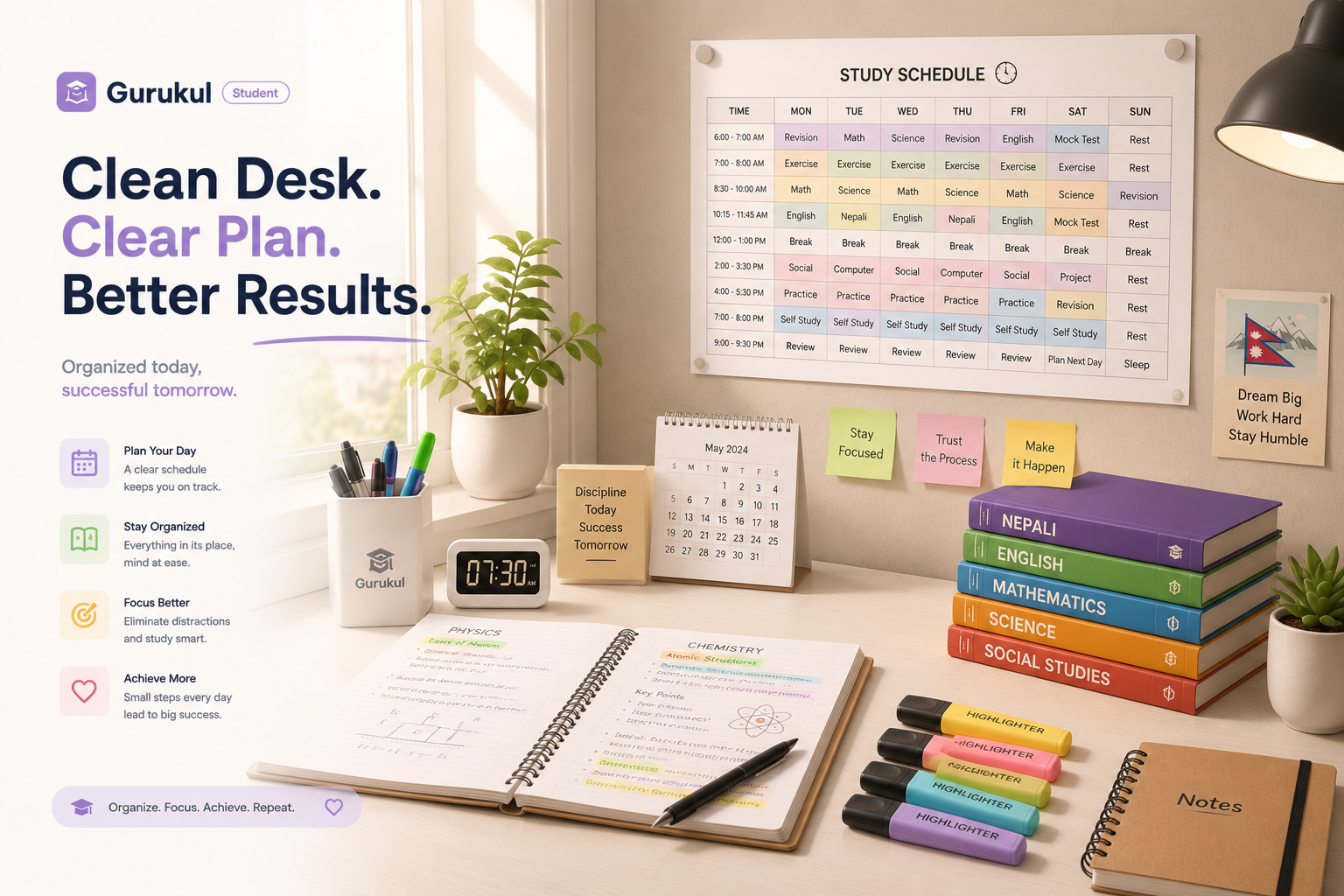
Ask ten students in Nepal how they study and most will describe the same thing: read the chapter, underline the important parts, copy the underlined parts into a notebook, read the notebook again before the exam.
It feels like work. It takes hours. And it is close to the least efficient way to prepare that has ever been formalised.
This is not a criticism of the students. It is what most of us were taught, and it has the fatal property of feeling effective while you do it - the material gets more familiar with every pass, and familiarity is easily mistaken for knowledge. The exam does not ask whether the page looks familiar. It asks you to produce the content with the book shut.
Everything below is about closing that gap.
Why Re-Reading Fails, in One Paragraph
When you re-read, you are recognising. When you sit an exam, you are retrieving. These are different mental operations, and practising one does not train the other. A student who has read a chapter six times will confidently recognise every sentence in it and still be unable to write a paragraph on the topic from memory, because they have never once practised producing it.
The fix is not more hours. It is changing what happens during them.
The Fundamentals Most Students Skip
Test yourself before you feel ready
Close the book and write down everything you remember about the topic. Then open it and see what you missed.
This is active recall, and the advantage it holds over re-reading is one of the most reliably reproduced results in learning research - the testing effect. It is unpleasant, because it shows you exactly how much you do not know, and that is precisely why it works. The gaps you find in a self-test on Tuesday are gaps you can still fix. The gaps you find in an exam hall are just lost marks.
The single most useful change most students can make: stop writing summaries, start writing questions. When you finish a topic, write five questions on it and nothing else. Come back in three days and answer them cold.
Spread the work out
Four one-hour sessions across four days beat one four-hour session, for identical total time. This is distributed practice, and it works because a little forgetting between sessions is what forces the retrieval that makes memory durable - the mechanism behind the forgetting curve.
Massed study before an exam produces a result that evaporates within a fortnight. That is survivable for a unit test. It is a disaster in Grade 10 and 12, where the terminal exam covers two years of content and you need Grade 9 material still in your head.
Mix your topics
Twenty algebra problems in a row teaches you to apply one method twenty times. Twenty mixed problems teaches you to work out which method the problem needs - which is the actual skill the exam tests.
Blocked practice feels smoother and produces better practice-session performance. Mixed practice feels clumsier and produces better exam performance. That trade, where the harder-feeling method is the more effective one, is common enough in learning research to have a name: desirable difficulty.
One habit combines all three. Keep a single sheet per topic containing only questions - no notes, no summaries. Every few days, pick a sheet at random and answer it from memory. That is retrieval, spacing and mixing in one twenty-minute block.
Subject-Specific Habits
The general principles apply everywhere, but each subject has a version that works better.
Mathematics
Work problems. Do not read worked solutions and nod - the nodding is the trap, producing the sensation of understanding with none of the ability to reproduce it.
A useful discipline: when you get a problem wrong, do not simply read the correct solution and move on. Write down which step you got wrong and why. "I used the wrong identity" and "I made an arithmetic slip" are completely different failures needing completely different fixes, and students who never separate them keep revising content when their real problem is care.
Keep a single page per chapter with every formula on it. Not a notebook - one page. If it does not fit on one page, you are copying rather than selecting.
Science
Notes by topic, not by chapter. When you study electricity, put every term, formula, diagram and common question type on one sheet, regardless of which chapters they came from. That sheet is what you revise in the final week, and it is worth more than forty pages of transcription.
Learn to draw the standard diagrams from memory - the eye, the heart, a plant cell, a circuit. They appear reliably and they are among the cheapest marks in the paper.
English and Nepali
These are the subjects where "studying" most often means reading, and reading is the least useful thing you can do with them.
For grammar, do exercises. Rules you can state but cannot apply are worth nothing in a transformation question.
For writing, write. Then get it marked - by a teacher, a classmate, or an AI tutor that will tell you what a marker would take marks off for. An essay you wrote and never had corrected has taught you almost nothing, because you have no idea which of your habits are costing you.
For literature, know the author, the theme and two or three quotable lines per text. Not the whole text.
Social Studies
This is the most memory-intensive subject and the one where flashcards genuinely pay. Make a card for every definition, date and figure and review them on rotation rather than in one block. It does not need deep understanding. It needs accurate recall, and accurate recall is exactly what spaced self-testing produces.
Managing Time Across Subjects
Most students allocate study time by preference. They study what they enjoy, which is usually what they are already good at, and the subject they are weakest in gets whatever is left - which is nothing.
Two rules fix most of this.
Weight by weakness, not by enjoyment. Your worst subject should get the most hours. This is uncomfortable and it is where nearly all the available improvement is.
Weight by credit. In a credit-weighted GPA, a four-credit subject moves your average twice as much as a two-credit one. An hour spent on a four-credit subject you are weak in is worth several hours spent perfecting something you already do well.
A simple weekly split for a student with six subjects: three sessions on the weakest, two each on the middle three, one each on the strongest two. Adjust monthly as the weak subject stops being the weak subject.
Sessions: Length, Structure and the Phone
Give every session a goal before it starts. Not "study Science" - "be able to explain refraction and answer five questions on it without notes". An open-ended session drifts. A session with a finish line ends when the work is done rather than when you get bored.
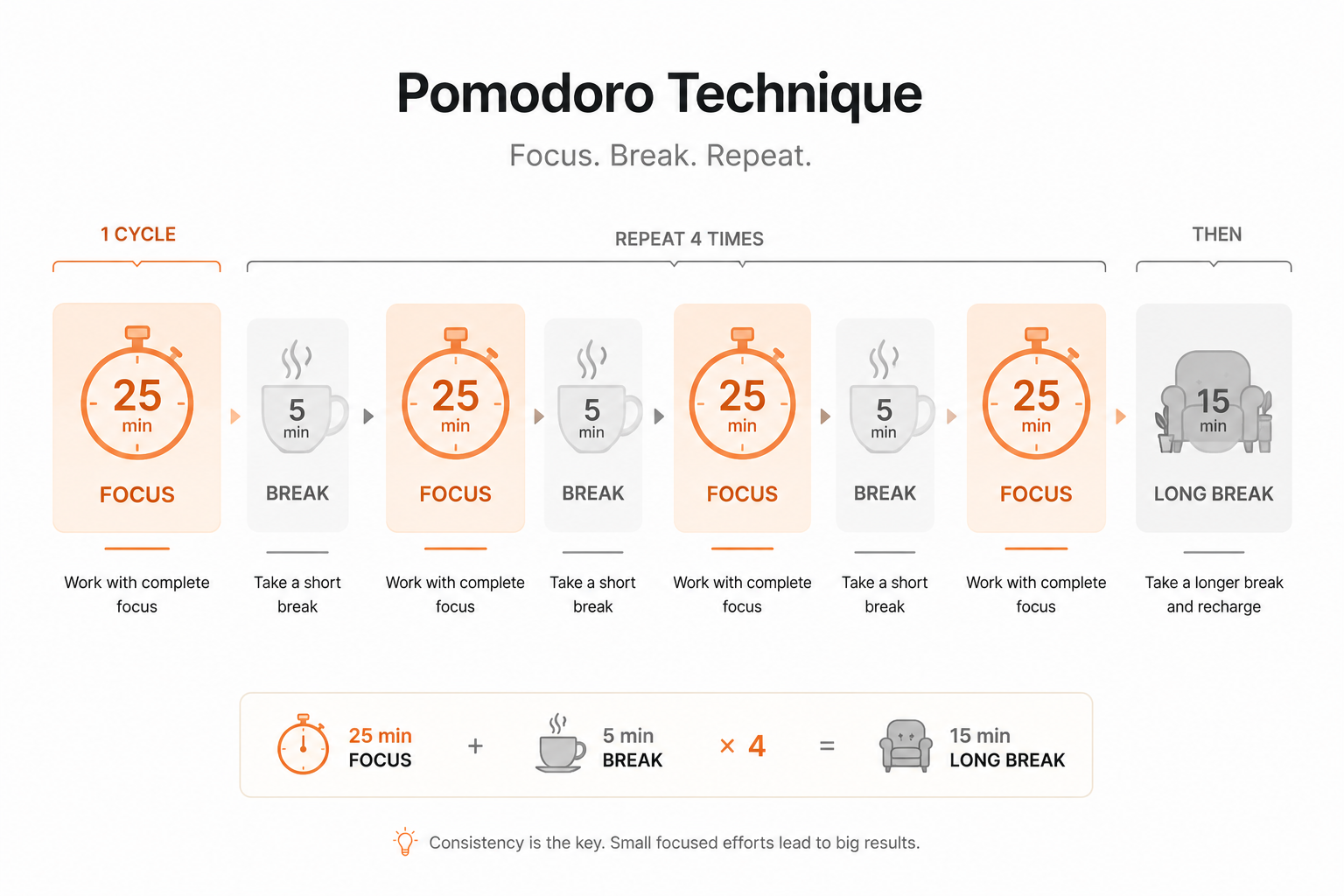
Work in blocks with real breaks. The Pomodoro technique - twenty-five minutes on, five off - suits some people; forty-five and ten suits others. The specific numbers matter far less than the principle: attention degrades over a long unbroken stretch, and a break taken deliberately is more restorative than one you drift into without noticing.
Put the phone in another room. Not face-down on the desk. In another room. A visible phone costs attention even when you do not touch it, because part of your mind is allocated to not touching it - a straightforward cognitive load problem. This is the single highest-return change most students can make and the one they resist most.
Stop before you are exhausted. A session that ends while you can still think leaves you willing to start the next one. Studying to the point of collapse trains you to dread the desk.
The Study Environment
You do not need a perfect setup. You need a consistent one.
Same place, same time, where possible. Habits attach to cues. Studying at the same desk at the same hour makes starting progressively easier, because the decision gets made once rather than daily.
Clear the desk of everything except this subject. Other subjects' books on the table are a low-grade distraction and a reminder of everything you are not doing.
Good light and a chair you can sit upright in. Studying in bed is comfortable and reliably ends in sleep or a phone.
Tell your family what you are doing and when. In a lot of Nepali households the study hour competes with everything else happening in a shared room. A stated, predictable slot is far easier for a family to protect than a vague intention to study more.
Procrastination, Treated Honestly
Most study advice treats procrastination as laziness. It usually is not. It is most often avoidance of a task that feels unpleasant, unclear or too large, and each of those has a different fix.
Too large. "Study Science" is not a task, it is a category, and the mind bounces off it. "Answer the five questions on my refraction sheet" is a task. Break work down until the first step takes under two minutes to start.
Unclear. If you do not know what "done" looks like, you cannot start. Define the finish line first.
Unpleasant. This is the honest one, and it usually means the subject is the one you are weakest in. The trick that works is committing to five minutes rather than to the session - starting is almost always the hard part, and five minutes in you are usually fine.
What does not work: waiting to feel motivated. Motivation follows starting far more reliably than it precedes it.
The Week Before an Exam
Do not learn new material. Whatever is not in your head by now will not go in usefully, and attempting it displaces revision of things you nearly know.
Revise from your one-page sheets, not from textbooks. If the sheets do not exist, this is what you will wish you had made three months ago.
Do timed past papers, and mark them strictly. The score is not the point. The list of question types you got wrong is the point, and it should set the rest of your week.
Protect sleep. Memory is consolidated overnight - sleep and memory are directly linked - so an all-nighter trades a few hours of low-quality revision for a measurable reduction in what you can retrieve the next morning. It is the worst trade available on the night before an exam, and it is the most popular one.
When You Do Not Understand Something
Do not move on. Unresolved confusion in Maths or Science compounds: the next topic assumes the one you skipped, and by the third chapter you have a gap you cannot locate.
In order of speed: ask a classmate who does understand it, ask an AI tutor to explain it a different way and keep asking until it lands, ask your teacher. All three are faster than the fourth option, which is quietly hoping it does not come up.
A test for whether you actually understand something: can you explain it out loud to someone who does not? If the explanation stalls, the understanding has a hole in it, and you have just found exactly where.
Tuition Classes and the Self-Study Trap
A large number of students in Nepal attend tuition alongside school, and many of them study less as a result rather than more.
The mechanism is simple. Tuition fills hours, feels productive, and is almost entirely passive - you sit, someone explains, you write down what they say. Attendance becomes a substitute for preparation. A student can spend fifteen hours a week in classrooms and never once close a book and test themselves.
Tuition is genuinely useful for one thing: getting an explanation of something you could not get elsewhere. It is not a substitute for the retrieval practice that actually moves a grade, and it competes for the hours in which that practice would have happened.
Two adjustments make it worth the money:
Arrive with a question. If you cannot name something specific you want cleared up, the session will wash over you. Write the question down before you go.
Book self-study time after every class, not before. An hour of working problems on what was just explained converts a passive session into a learned one. Without it, you have watched someone else do maths.
Studying Around Load-Shedding and Bad Internet
Advice written elsewhere assumes constant electricity and a reliable connection. Plenty of students in Nepal do not have either, and "study at your desk with your laptop" is not always an available plan.
Keep an offline queue. Decide in advance what you will do when the power is out: past papers on paper, working problems, flashcards, writing practice. All of these are better uses of an hour than watching a video anyway, so a cut becomes a prompt to do the higher-value work rather than a reason to stop.
Download before you need it. If your study material lives in an app or on video, pull it down while the connection is good. The moment to discover that a resource needs the internet is not the evening before a test.
Do the connected work in the connected window. Asking an AI tutor, looking things up, downloading past papers - batch these into the times you know you have power and signal, and leave the rest for paper.
This sounds like a workaround. In practice, students who build this habit end up doing more retrieval practice than students with perfect connections, because paper-based work is inherently active and video is inherently passive.
Group Study, Done Properly
Group study has a bad reputation in Nepal and mostly deserves it, because most of it is three friends with open books talking about something else.
It can work, but only in a specific form: test each other, do not study together.
The version that works is one person asking questions and the others answering from memory, out loud, in turn. This is retrieval practice with social pressure attached, which makes it harder to quietly skip the bits you do not know. Explaining a topic to someone who does not understand it is also the fastest way to find the holes in your own understanding.
The version that does not work is sitting in the same room reading separately, which is just studying alone with distractions, or one person explaining while the rest listen, which is a lecture with worse preparation.
Keep it to two or three people and one subject per session, and end it at a fixed time.
Checking Whether Any of This Is Working
The point of changing how you study is a changed result, and it is worth measuring rather than assuming.
Every fortnight, sit one timed past-paper section cold. Not a full paper - one section, forty minutes. Mark it strictly.
Track two numbers: the score, and the proportion of lost marks that were careless rather than unknown. The first tells you whether you are learning. The second tells you whether your problem is knowledge or execution, and those need completely different responses.
If the score is flat after a month of honest effort, something in the method is wrong - most often that "studying" has quietly reverted to re-reading. If the score is rising but careless errors are not falling, the content is fine and you need to practise under time pressure instead.
Setting Targets That Do Something
Vague intentions do not survive a busy week. Specific, written, measurable ones do - which is the whole finding behind goal setting research.
"Do better in Maths" is not a target. "Move Maths from B to B+ by fixing trigonometry and cutting careless errors, checked against a past paper every fortnight" is one, because you can tell at any point whether it is happening.
Write three of those at the start of a term. Check them monthly. Change them when the evidence says to.
The Bottom Line
The students who do well are rarely the ones who study the most hours. They are the ones whose hours are spent retrieving instead of re-reading, spread out instead of crammed, aimed at their weakest subject instead of their favourite, and undisturbed by a phone.
None of that requires talent, money or a better school. It requires deciding that the uncomfortable version of studying is the one that works, and then doing it on the days you do not feel like it.