

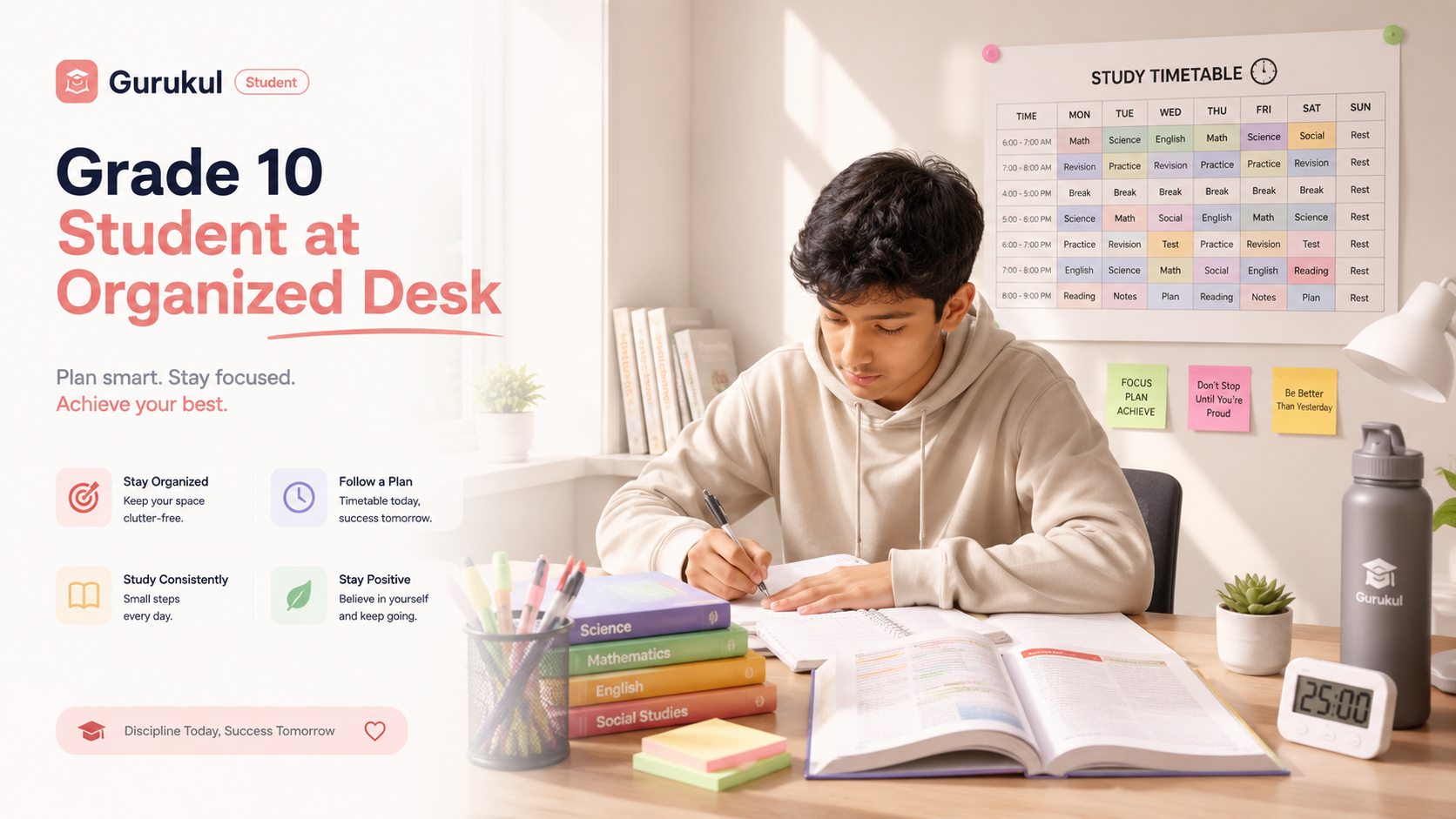
The Secondary Education Examination - the SEE - is the exam that most determines what comes next in a Nepali student's academic life. The result shapes which stream you can enter in Grade 11, which college accepts you, and in many families, how the next few years are discussed at the dinner table.
No pressure, right?
Here is the thing worth holding on to: the SEE is not a test of brilliance. It is a test of preparation. Every year, students who are not the "smartest" in their class outperform students who are, because they prepared systematically. And every year, students who could have done much better do not, because they started too late or prepared in a way that felt productive without being productive.
This guide is about the difference between those two.
Understanding What the SEE Actually Tests
Before any study strategy, it helps to be honest about what the exam rewards.
The SEE is a written examination covering the compulsory subjects of the Grade 9-10 curriculum: Compulsory Nepali, Compulsory English, Compulsory Mathematics, Science and Technology, Social Studies and Human Values Education (SSHVE), and Health, Physical and Creative Arts, plus optional subjects such as Optional Mathematics, Computer Science or Accountancy.
The exam rewards four things:
- Recall. Definitions, formulas, dates, geographic facts, the labelled parts of a diagram.
- Application. Using a formula or concept on a problem you have not seen in exactly that form, mostly in Maths and Science.
- Expression. Writing clearly in Nepali and English - essays, letters, summaries, comprehension answers.
- Accuracy. Particularly in Maths, the right answer arrived at by the right steps, with the right units.
What it does not reward: creativity, original argument, going beyond the textbook, or writing a more sophisticated answer than the mark scheme expects. The SEE has specific marking rubrics. An answer that matches them gets full marks. An answer that goes beyond them gets the same marks, and sometimes fewer, if the structure the marker is looking for is buried inside it.
That is not a criticism of the exam. It is simply a fact that should shape how you spend your hours.
How Your SEE Result Is Actually Calculated
A surprising number of students prepare for the SEE without knowing how the number at the end is produced. It is worth ten minutes, because it changes where you spend your effort.
Nepal uses letter grades rather than raw pass or fail. Each subject earns a grade, each grade carries a grade point, and your GPA is the average of those grade points weighted by each subject's credit hours. The current scale, set by the Curriculum Development Centre and applied by the National Examinations Board, works out as:
Three consequences follow, and they are the ones students most often miss.
One weak subject drags the whole average. Because the GPA is a mean, an A+ in five subjects and a D in Maths does not average out to "very good". It averages out to somewhere around 3.4, which closes doors that 3.8 would have opened. The single highest-return hour of study you can spend is on your worst subject, not your best.
The jump between adjacent grades is not evenly spaced in effort. Moving from 68 to 72 marks is one grade band and usually a matter of a few careless errors. Moving from 88 to 92 is also one grade band and is genuinely hard. If you are hunting for GPA, the cheapest points are almost always in the subjects where you are sitting just under a boundary.
Streams have thresholds, not rankings. Science streams at competitive colleges typically ask for a specific GPA and a minimum grade in Maths and Science specifically. Knowing the threshold you are aiming at turns a vague "do well" into a target you can actually plan around. Ask your school what the colleges you care about asked for last year.
When to Start, and What "Starting" Means
Twelve months or more. You have time to understand rather than memorise. Spend it on Maths and Science, because those are the two subjects it is hardest to fake in the final weeks.
Six months. Enough to cover every subject, work through past papers, find your weak areas and still have time to fix them.
Three months. You need to be selective. Prioritise the high-weightage topics in each subject. Do not try to cover everything to the same depth - you will run out of time and cover nothing properly.
Under three months. Past papers, almost exclusively. The SEE pattern is consistent year to year. What has come before will come again, in a slightly different costume.
"Starting" does not mean sitting down with a textbook once and feeling virtuous about it. It means a routine you keep. One long session a week is not preparation. Two focused hours a day, most days, is.
The Three Techniques That Actually Work
Most students study by reading notes over and over. It feels like learning because the material gets more familiar each pass. Familiarity is not the same as recall, and the exam asks for recall.
Three techniques have far better evidence behind them, and all three feel harder while you are doing them. That is not a coincidence - the difficulty is where the learning comes from, an effect researchers call desirable difficulty.
Test yourself instead of re-reading. Close the book and write down everything you remember about photosynthesis, then open it and see what you missed. This is active recall, and the improvement it produces over re-reading is one of the most reliably reproduced findings in learning research - the testing effect. It is uncomfortable precisely because it shows you what you do not know, which is the entire point.
Spread your study out instead of massing it. Four one-hour sessions across four days beat one four-hour session, for the same total time. This is distributed practice, and it works because forgetting a little and then retrieving it again is what makes a memory durable - the mechanism behind the forgetting curve and behind spaced repetition systems.
Mix topics rather than blocking them. Twenty algebra problems in a row teaches you to apply one method twenty times. Twenty mixed problems teaches you to work out which method a problem needs, which is what the exam actually asks. The first feels smoother. The second is what transfers.
A cheap way to combine all three: keep one sheet per topic with nothing on it but questions. Not notes, not summaries - questions. Every few days, pick a sheet at random and answer it from memory. Check afterwards. That single habit is active recall, spacing and mixing at the same time.
Subject-by-Subject Strategy
Compulsory Mathematics
Maths is the subject that most separates SEE results, and for the reason in the GPA section above: it is where the low grades cluster. It usually deserves 30-35% of your total study hours.
Prioritise:
- Algebra: equations, simultaneous equations, quadratics, polynomials
- Geometry: theorems (circle theorems and triangle congruence especially), construction
- Trigonometry: exact values, identities, height and distance
- Statistics: mean, median, mode, quartiles, probability
- Set theory: Venn diagrams, set operations
How to study it: work problems. Do not read solutions. A problem you attempted, got wrong and then corrected stays with you; a solution you read and nodded along to does not. The nodding is the trap - it produces the feeling of understanding without the ability to reproduce it.
Do at least five years of past Maths papers under timed conditions. If you can finish one in the allotted time and score above 70%, you are on track.
For each topic, find the three or four question types that appear in every single SEE paper. Master those first, then move outward to the rarer ones. Your time is finite - spend it in proportion to what actually appears.
Science and Technology
Science is knowledge-heavy across Physics, Chemistry, Biology and Botany.
High-weightage topics first:
- Physics: pressure, light (refraction, lenses), electricity, force and motion
- Chemistry: metals and non-metals, chemical reactions, acids and bases
- Biology: human body systems (respiratory, circulatory, digestive), cell structure
- Botany: photosynthesis, plant cells, reproduction
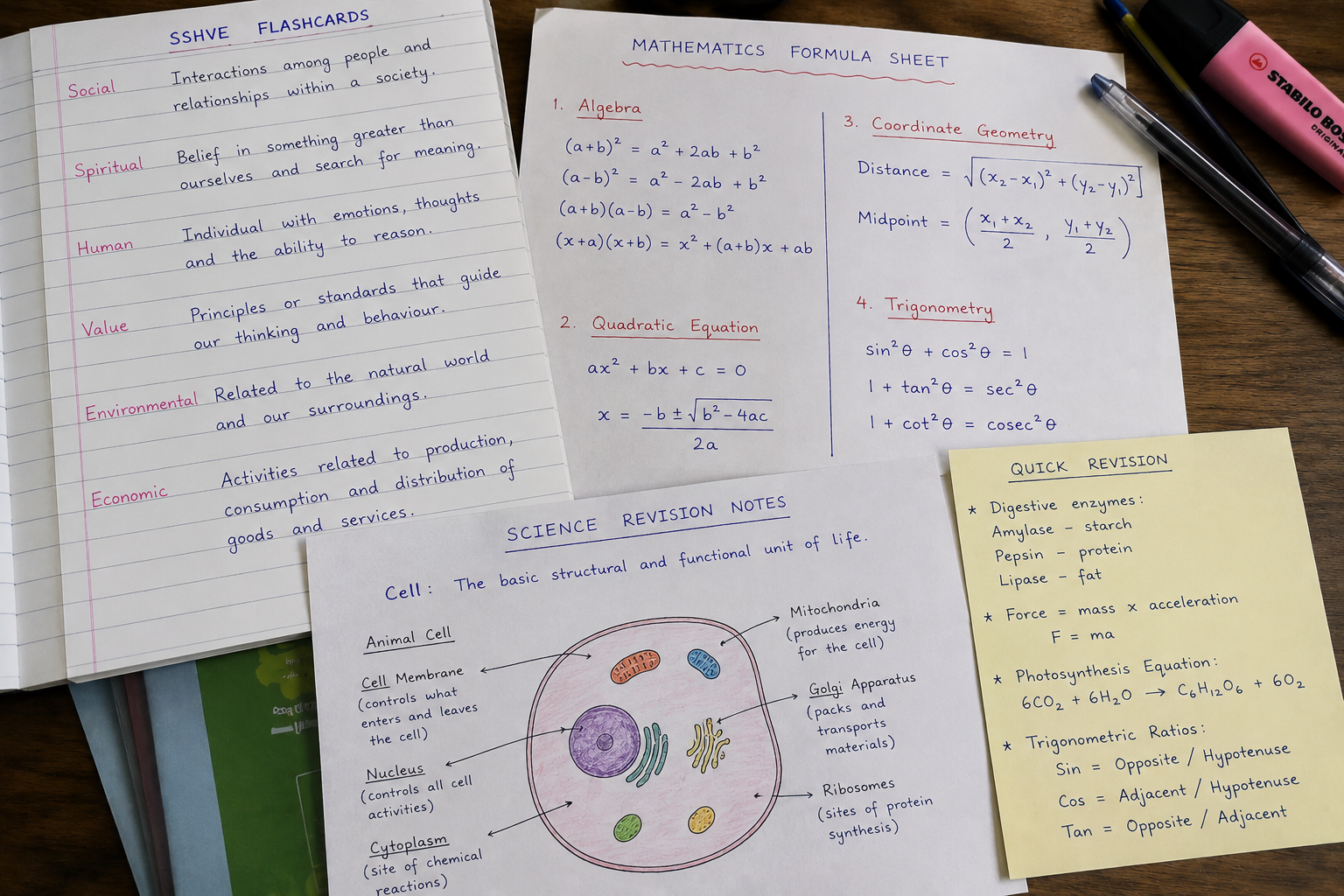
How to study it: make notes by topic, not by chapter. When you study electricity, put every key term, formula and common question type on one page. That page is your revision sheet in the final week, and it is worth more than forty pages of transcribed textbook.
Diagrams matter more than students expect. The human eye, the heart, a plant cell, a simple circuit - learn to draw and label these accurately from memory. They appear in almost every paper and they are among the easiest marks available.
Compulsory English
Three components: reading comprehension, grammar, and writing.
Grammar that appears every year: tenses (present perfect versus past simple especially), passive voice, reported speech, conditionals, question tags, gerunds and infinitives.
Writing: practise against real past-paper prompts, not generic essay practice. The paper reliably includes a formal letter, a composition, or both, and the marks are in the structure as much as the content - salutation, paragraphing, closing.
Reading comprehension: answer from the passage. Find the sentence that supports your answer before you write it. Marks are lost every year by students who answer from general knowledge instead of from the text in front of them.
Compulsory Nepali
For students who grew up speaking Nepali, this is the subject most often under-prepared, because it feels like something you already know. The exam is not testing whether you can speak it.
Key components: grammar (sandhi, compound words, sentence transformation, parts of speech), literature from the Grade 9-10 curriculum (author, theme, key lines), and writing (darkhast, patra, nibandha, saar).
The Nepali paper rewards precision with rules. Knowing a rule loosely is not enough - you need to apply it correctly in a sentence you have not seen before.
Social Studies and Human Values Education
SSHVE is the most memory-intensive subject in the exam: geography, history, economics, civic education and human values.
It does not require deep understanding. It requires accurate recall, which makes it the subject where flashcards and self-testing pay off most directly. Make a card for every definition, date and figure, and review them on a rotation rather than in one block before the exam.
Geography: Nepal's physical features, rivers, mountains, climate zones, and world geography at textbook level. History: the key dates, events and figures of Nepal's political history, in order. Economics: basic concepts, Nepal's development indicators, trade.
A Twelve-Week Schedule
This assumes roughly three months. Adjust the proportions towards whichever subjects you are weakest in.
Weeks 1-3: understand. Work through each subject's major topics. Do not memorise yet. Where something does not make sense, resolve it now - ask a teacher, ask an AI tutor, find an explanation video. Moving on with unresolved confusion is how a small gap becomes a lost grade.
Weeks 4-7: practise. Maths problems, Science questions, English grammar exercises, Nepali compositions. Weight this towards your weak topics, not the ones you enjoy.
Weeks 8-10: past papers. One full paper per subject, timed, marked honestly against the scheme. The purpose is not the score. The purpose is the list of question types you got wrong.
Weeks 11-12: targeted revision and rest. Revise only what the past papers exposed. Do not start new material. Sleep properly - memory is consolidated during sleep, which is why sleep and memory are so tightly linked and why an all-nighter before a paper reliably costs more than it gains.
Past Papers: Where to Get Them and What to Do With Them
Past papers are the single most useful resource available to you, and they are free. Your school almost certainly keeps a set. The Curriculum Development Centre publishes the curriculum and specification grids that the papers are built from, and the National Examinations Board is the authority for the examination itself. Between the two you can see both what is examinable and how it tends to be asked.
Doing a past paper badly is easy and nearly useless: open the paper, look at a question, look at the answer, feel informed. Doing one properly takes three hours and is worth ten of the other kind.
- Sit it timed, in one go, without notes. The pressure is part of what you are practising.
- Mark it yourself against the scheme, strictly. Give yourself the marks a marker would, not the marks you feel you deserve.
- Categorise every lost mark. Was it a knowledge gap, a careless error, or a time problem? These need completely different fixes, and students routinely apply the wrong one - revising harder when the real issue was running out of time.
- Fix the top category, then sit another paper.
By the third or fourth paper the pattern in your own mistakes becomes obvious. That pattern is the most valuable thing you will learn in the whole preparation.
Using an AI Tutor Well
If you have access to an AI tutor - Vidya in the Gurukul student app, or anything similar - it is genuinely useful for four things and genuinely harmful for a fifth.
Explaining a concept a different way. When the textbook explanation does not land, ask for another one. Ask for an example. Ask "why" until it makes sense. An AI tutor will explain the same idea six times without sighing, which is not a small thing.
Generating practice. "Give me five SEE-style questions on circle theorems." Work them, then ask it to check your method rather than just your answer. The method is what the marker sees.
Feedback on writing. Write a Nepali essay or an English composition, then ask what a marker would take marks off for. You get specific, structural feedback - paragraphing, missing salutation, unsupported point - of the kind that is hard to get for every draft otherwise.
Being asked questions. Ask the tutor to test you rather than to explain to you. "Ask me ten questions on the digestive system, one at a time, and tell me if I am wrong." This turns the tool into active recall, which is where the actual learning is.
What not to do: do not ask it for answers to copy. Not because it is cheating in a way anyone will catch, but because the answer ends up in its output box rather than in your head, and the exam hall contains only your head. A student who has an AI write their homework for a term arrives at the SEE having practised nothing.
Common Mistakes That Cost Marks
Not reading the question properly. Students regularly answer a slightly different question than the one asked. Read it twice. Underline the instruction verb - describe, explain, calculate, compare are four different tasks.
Overrunning on one question. Spending forty-five minutes on a question worth five marks and then rushing three worth twenty is the most expensive time error in the exam. Practise the timing, not just the content.
Leaving blanks. Most SEE subjects award partial marks. An incomplete attempt often earns something. A blank always earns zero. Write the formula even if you cannot finish the calculation.
Dropping units. "40" is not an answer to a pressure question. "40 Pa" is. Units are free marks and they are thrown away every year.
Memorising formulas without understanding them. A student who has memorised the area of a triangle often cannot use it when the question gives the information in an unfamiliar order. Understanding why a formula works is what makes it flexible under pressure.
Nerves, and What To Do About Them
Some anxiety before an exam is normal and even useful. Test anxiety becomes a problem when it stops you retrieving things you actually know, which is a specific and fixable failure rather than a character flaw.
Three things help more than reassurance does:
- Practise under real conditions. Most exam-hall panic is unfamiliarity. Timed past papers make the real thing boring, which is exactly what you want it to be.
- Have a first move. Decide in advance what you do in the first two minutes: read the whole paper, mark the questions you can definitely do, start with one of those. A plan removes the moment of blankness where panic starts.
- Sleep. It is the least glamorous item on the list and the one with the largest effect.
The Night Before
Do not learn new material. It does not work and it raises your anxiety at the worst possible time.
Instead: review your summary sheets, not the textbook. Lay out your pens, pencil, ruler, calculator if it is allowed for that paper, and your admission card. Eat a proper meal. Sleep by ten.
In the morning: eat breakfast, arrive early, and read every question before you write anything.
If It Does Not Go To Plan
Not every result is the one that was hoped for, and it is worth knowing in advance that a disappointing SEE is not the end of the road. Nepal runs grade increment examinations for students who want to improve a grade, and many students go on to strong Grade 11 and 12 results from an average SEE. Your school can tell you the current process and deadlines, and the National Examinations Board publishes the official schedule.
The result matters. It is also one exam, taken at sixteen, and the years after it are longer than the months before it.
The Short Version
Learn how the GPA is built, then spend your hours where the grades are actually being lost. Test yourself instead of re-reading. Spread the work out. Do past papers properly and let your own mistakes set your revision list. Sleep.
None of that is clever. It is just what preparation looks like when it is done on purpose rather than by accident, and it is available to every student sitting the exam - including the ones who assume the top of the class is out of reach.